What Dropshipping Actually Is
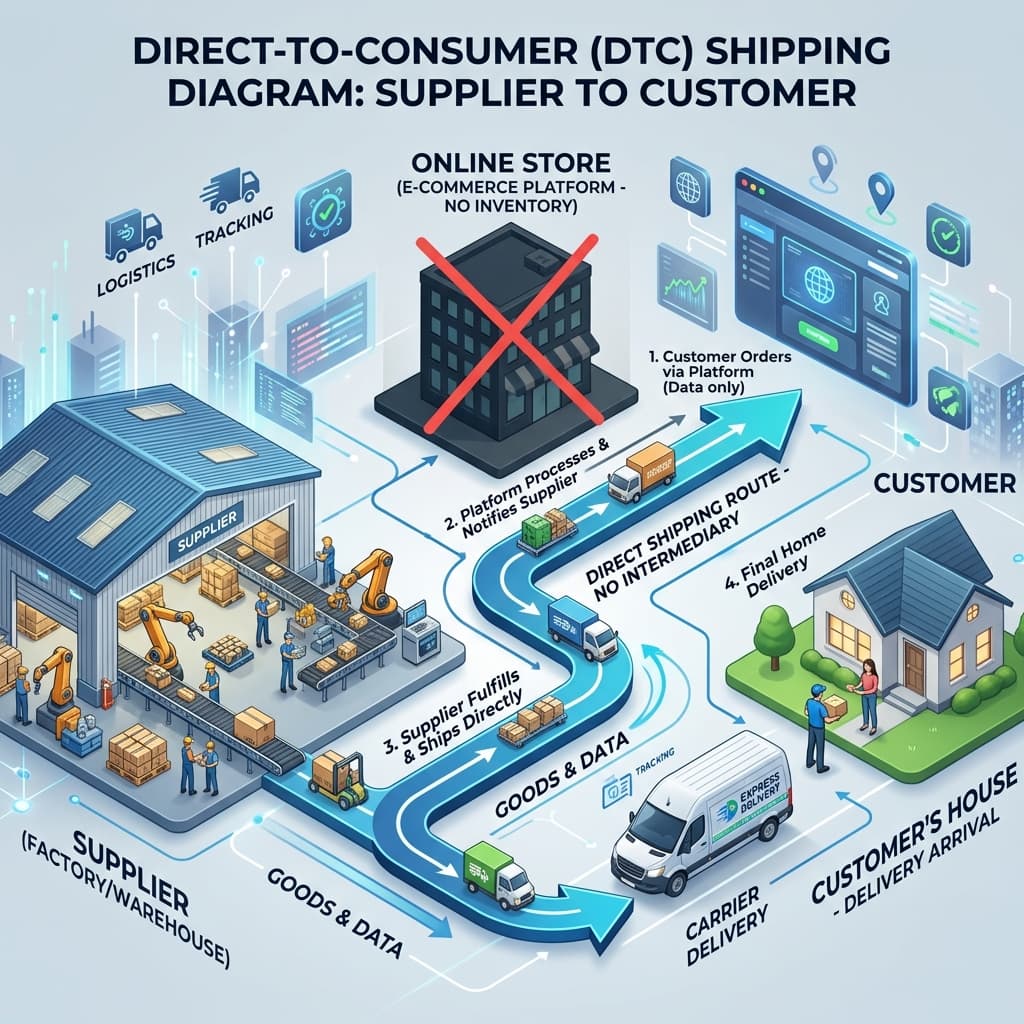
Dropshipping is a retail fulfillment model where you sell products on your online store without ever holding inventory. When a customer places an order:
- They pay your retail price on your store
- You forward the order details (and the wholesale cost) to your supplier
- The supplier ships the product directly to the customer with no return address from you
- You keep the margin between retail price and wholesale cost
You never touch the product. You never rent a warehouse. You never pay for inventory upfront. The supplier handles fulfillment; you handle the brand, the store, and (most importantly) the marketing.
Why People Start Dropshipping
- Low startup capital — you can launch a real store for under $1,000
- No inventory risk — you only pay for products you've already sold
- Location independent — manage the business from anywhere with internet
- Scalable model — adding more products doesn't require more warehouse space
- Test products fast — list a product today, run ads tomorrow, kill it next week if it flops
Why Most Dropshippers Fail
Honest perspective: the majority of dropshipping stores never break even. The most common reasons:
- They pick saturated products (everyone else is running the same Meta ads)
- They burn ad budget without learning how to read the data
- They have no retention layer — every order costs them ad spend
- They expect fast riches and quit when month 2 isn't profitable
- They use slow AliExpress shipping in markets that expect 3-day delivery
The dropshippers who succeed treat it like a real business: branded packaging where possible, real reviews, retention via email + push, and patience to iterate on creative.
The 8-Step Plan to Start Dropshipping in 2026
Step 1 — Pick a Niche With Margin Headroom
Don't pick "what you're passionate about" — pick a niche with:
- 60%+ gross margin per product
- Solves a real problem or has wow factor
- Not heavily saturated on TikTok/Meta in your target country
- Compliant (no IP issues, no overly-regulated categories)
- Easy to ship globally (lightweight, non-fragile)
Examples that have worked in 2026: pet accessories, home gym gear, kitchen gadgets, eco-friendly products, posture aids, car accessories.
Step 2 — Find Suppliers
Tools and platforms by region:
- AliExpress — global, cheapest, but slow shipping
- Spocket — US/EU suppliers, faster shipping
- CJ Dropshipping — global with private-label options
- Zendrop — automation-focused for US dropshippers
- AutoDS — multi-supplier automation
- Printful / Printify — print-on-demand for apparel/accessories
For US/UK/EU markets, prioritise suppliers with sub-10-day shipping. For India/SEA, AliExpress shipping is fine because customers expect longer times.
Step 3 — Pick Your Store Platform
The two real choices in 2026:
| Platform | Best for |
|---|---|
| Shopify | Beginners, fast launch, easier learning curve |
| WooCommerce | Better margins at scale, full data ownership, more flexibility |
We covered both in detail in Shopify dropshipping and WooCommerce dropshipping guides.
Step 4 — Build the Store
- Custom domain (no myshopify.com URLs)
- Professional theme (lightweight, mobile-first)
- Real product photos (or AI-edited photos, not copy-pasted from AliExpress)
- Authentic-sounding product descriptions
- Trust badges, shipping policy, returns policy
- Reviews (collect from beta users, never fake)
Step 5 — Set Up Payments
Stripe + PayPal as a minimum. For your country:
- US/UK/EU/AU/CA: Stripe + PayPal (standard)
- India: Razorpay + UPI + Stripe
- UAE/Saudi: Tabby/Tamara (BNPL big in MENA) + Stripe
- Brazil: Mercado Pago + Pix + Stripe
- Mexico: Mercado Pago + OXXO + Stripe
- Singapore/SEA: Stripe + GrabPay + local wallets
- Indonesia: Xendit + local wallets (OVO, DANA, GoPay)
Step 6 — Launch the Ad Stack
Start with one platform; expand once you find a winner:
- Beginners: TikTok ads (cheap CPMs, forgiving algo)
- Visual products: Meta Ads (Instagram + Facebook)
- High-intent search: Google Shopping + Performance Max
Budget: $30–50/day per ad set, kill underperformers fast at the 3-day mark.
Step 7 — Build the Retention Engine
This is where 80% of dropshippers fail because they skip it. Add:
- Email (Klaviyo or Omnisend) — abandoned cart, post-purchase, win-back flows
- Push notifications via a mobile app — highest open rates of any channel
- Loyalty (Smile.io) — drive repeat purchase
- SMS or WhatsApp (regional)
A mobile app for your dropshipping store lifts repeat purchase rate 3–4x. BrewmyApp builds it in a week with unlimited push notifications.
Step 8 — Track, Iterate, Scale
Track ROAS, repeat purchase rate, and gross margin weekly. Scale winners, kill losers, iterate on creative.
Dropshipping by Country — What to Watch
Dropshipping is legal globally but has country-specific rules. The non-exhaustive guide:
Dropshipping in the United States 🇺🇸
- Legal structure: Register an LLC (Wyoming, Delaware or your home state). Get an EIN from the IRS.
- Sales tax: You're responsible for sales tax in any state where you have nexus (TaxJar or Avalara handles this).
- Suppliers: US-based dropshippers via Spocket, CJ US warehouses, Zendrop ship in 3–7 days — competitive with Amazon Prime expectations.
- Top niches in 2026: home gym, pet products, EV accessories, sleep/recovery gear.
Dropshipping in the United Kingdom 🇬🇧
- Legal structure: Sole trader or Ltd company via Companies House. Register for VAT once revenue passes £90,000.
- VAT: Charge 20% VAT on UK sales. Post-Brexit, EU sales need IOSS registration.
- Suppliers: UK-based via Spocket UK, Avasam, Modalyst — shipping in 2–5 days.
- Top niches in 2026: sustainable products, pet accessories, home/garden, fitness.
Dropshipping in India 🇮🇳
- Legal structure: Sole proprietorship, LLP, or Private Limited. Register on Udyam (MSME) for benefits.
- GST: Register for GST once revenue passes ₹40 lakh (₹20 lakh in some states). Charge GST on sales.
- Payments: Razorpay + UPI is essential. COD still expected by 30–40% of customers.
- Suppliers: Meesho Supplier Hub, IndiaMART, GlowRoad, AliExpress India.
- Shipping: Shiprocket, Delhivery, XpressBees for local fulfillment.
- Top niches in 2026: ethnic fashion, ayurvedic/wellness, electronics accessories, home decor.
- Marketing: WhatsApp essential. Meta Ads + Instagram dominate. YouTube Shorts and Reels work for younger demos.
Dropshipping in Australia 🇦🇺
- Legal structure: ABN (Australian Business Number). Register for GST at AUD 75,000 revenue.
- GST: 10% on local sales. Imported goods under AUD 1,000 also subject to GST since 2018.
- Suppliers: Local AU dropshipping via Avasam, Spocket AU. AliExpress shipping is 14–21 days to AU.
- Top niches in 2026: outdoor/camping, pet products, kitchen gadgets, beauty.
Dropshipping in Canada 🇨🇦
- Legal structure: Sole proprietorship or Incorporation (federal or provincial).
- GST/HST/PST: Register for GST at CAD 30,000 revenue. PST in BC/SK/MB; HST in Atlantic + ON.
- Suppliers: Spocket CA, Doba, US suppliers ship in 5–10 days.
- Top niches in 2026: winter gear, fitness, home goods, pet products.
Dropshipping in the UAE 🇦🇪
- Legal structure: Trade licence required — Mainland or Free Zone (Sharjah Media City, RAKEZ, IFZA are popular for ecommerce).
- VAT: 5% on local sales. Register at AED 375,000 revenue.
- Payments: Stripe + Tabby/Tamara (BNPL) + COD (still 20–30% of orders).
- Suppliers: Local UAE via Spocket MENA, AliExpress (fast Dubai-bound shipping), regional warehouses.
- Top niches in 2026: luxury accessories, perfumes, electronics, modest fashion.
- Marketing: Instagram + TikTok dominate. Snapchat strong with Gen Z. Arabic ad creative converts better than English in many segments.
Dropshipping in Germany 🇩🇪
- Legal structure: Gewerbeanmeldung (business registration). UG or GmbH for limited liability.
- VAT: 19% standard rate. Register for VAT and Verpackungsregister (LUCID) for packaging waste compliance.
- Suppliers: Local German via BigBuy, Spocket EU, Avasam. EU suppliers within Schengen for fast shipping.
- Top niches in 2026: sustainable products, home/garden, fitness, pet accessories.
- Important: GDPR compliance is strict. Cookie consent (Cookiebot, Borlabs) and clear data policies are non-negotiable.
Dropshipping in France 🇫🇷
- Legal structure: Auto-entrepreneur for small scale, SARL/SAS for larger operations.
- VAT: 20% standard rate.
- Suppliers: BigBuy, Spocket EU, local FR via Avasam.
- Top niches in 2026: beauty, fashion, home decor, eco products.
- Marketing: Meta Ads dominant. TikTok growing fast.
Dropshipping in Brazil 🇧🇷
- Legal structure: MEI (Microempreendedor) for under R$81,000/year, or LTDA at scale.
- Taxes: ICMS (state), PIS/COFINS, complex tax stack — work with a contador (accountant).
- Payments: Pix is dominant; Mercado Pago + boleto + cards.
- Suppliers: Local Brazil suppliers via Yampi, Dropi, Shopee, MercadoLivre.
- Top niches in 2026: beauty, fitness, home, mobile accessories.
- Marketing: Instagram + TikTok + Kwai. WhatsApp Business critical.
Dropshipping in Mexico 🇲🇽
- Legal structure: Persona Física or Persona Moral. Register with SAT and RFC.
- Taxes: IVA 16%, ISR income tax.
- Payments: Mercado Pago + OXXO + tarjeta + transferencias.
- Suppliers: Local MX via Latitude Cero, regional CJ warehouses, AliExpress.
- Top niches in 2026: beauty, fashion, home, fitness, electronics.
Dropshipping in Singapore 🇸🇬
- Legal structure: Sole Proprietorship or Pte Ltd via ACRA.
- GST: 9% (rising) — register at SGD 1M revenue.
- Payments: Stripe + GrabPay + PayNow + cards.
- Suppliers: Regional SEA suppliers, AliExpress fast to SG, Shopee/Lazada warehouses.
- Top niches in 2026: tech accessories, beauty, fitness, premium home goods.
- Marketing: Meta + TikTok + Google. Strong English + Mandarin creative mix.
Dropshipping in Indonesia 🇮🇩
- Legal structure: CV or PT for serious operations. SIUP / NIB registration.
- VAT (PPN): 11% on local sales.
- Payments: Xendit + OVO + DANA + GoPay + bank transfer + COD.
- Suppliers: Local ID via Shopee/Tokopedia warehouses, regional CJ, AliExpress.
- Top niches in 2026: modest fashion, beauty, mobile accessories, home goods.
- Marketing: TikTok dominates Gen Z. Instagram + Shopee Live strong. WhatsApp essential.
Country-Agnostic Best Practices
Regardless of where you operate:
- Register a real business. Hobby dropshipping doesn't survive tax season.
- Comply with local consumer protection. Returns, refund windows, distance-selling rules — know your country's rules.
- Get the right insurance. Product liability matters once you scale.
- Use a tax tool. TaxJar, Quaderno, Avalara — automation pays back ten times over.
- Build a retention layer early. Email, push and loyalty — start month one, not month six.
- Plan for a mobile app. Once you find a winning product, a mobile app compounds your retention and lowers per-order ad cost.
The Honest Timeline
Realistic expectations for a serious new dropshipper:
- Month 1: Setup + first product tests. Probably losing money.
- Month 2–3: Find one winning product. Breaking even or small profit.
- Month 4–6: Scale ads + add email retention. Net profit becomes consistent.
- Month 6–9: Add SMS, loyalty, and mobile app for retention compounding.
- Month 9–12: Diversify products, expand to a second country if margin supports it.
This is a 12-month game, not a 12-week one. The dropshippers who treat it like a sprint quit; the ones who treat it like a business compound.
When to Add a Mobile App
The moment you have:
- 1,000+ paying customers
- One winning product driving consistent orders
- A repeat purchase rate above 10% (proves there's a base to retain)
…build a mobile app for your store. Push notifications + home screen presence will lift your retention from 10–15% to 30–40% within 90 days, and your blended ROAS rises with it.
Start building your dropshipping mobile app free
Related reads:
Ready to Turn Your Store into a Mobile App?
Design and preview your app for free. No coding required.
Start Building for Free