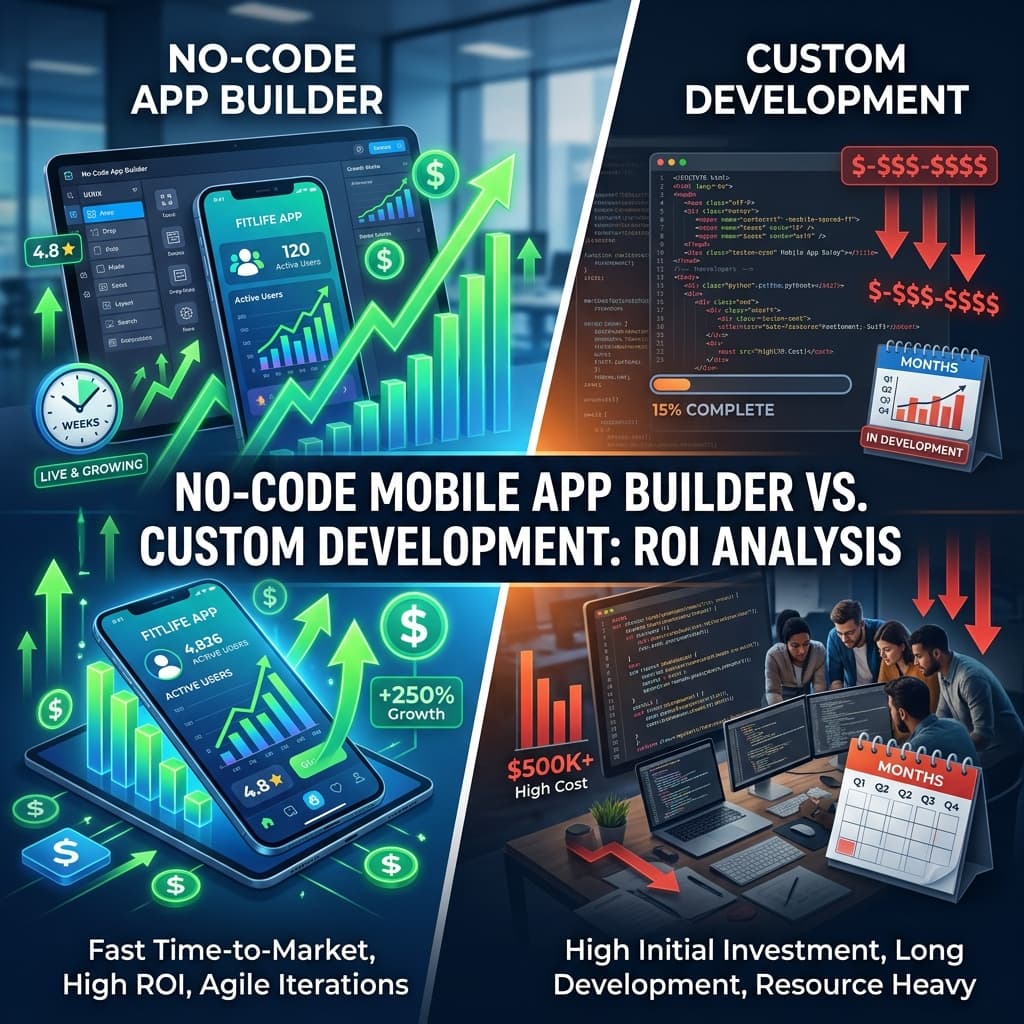
The short answer
Building a custom ecommerce app costs $20,000 to $300,000. Maintaining it costs roughly 15–25% of that every year, forever.
Using a builder costs $99/month, and the maintenance is included.
Both numbers are honest. Which one applies to you depends on a single question, and it is not the one most people ask. It is not "how much does an app cost" — it is "how much of this app has to be unlike everybody else's?" If the answer is "the branding, the products and the feel", you are describing a configuration problem, and paying for a bespoke build is paying five figures to rediscover solved problems. If the answer involves a booking engine nobody has built, a checkout that breaks the normal rules, or a proprietary loyalty scheme, you need developers and no builder will rescue you.
Most stores are the first kind. Almost every quote is priced for the second.
What the agencies actually quote
Search for what an ecommerce app costs and you will be quoted between $20,000 and $300,000 — roughly $20,000–$50,000 for a basic build, $50,000–$120,000 for something mid-sized, and $120,000 upwards for anything an agency calls enterprise. Those are development-shop numbers for a bespoke build, and they are real quotes for real work.
They also almost never include what happens next year.
Those figures are consistent across the development shops publishing cost guides in 2026, and they are not padded. A team really does spend that: discovery, design, iOS and Android builds, an API layer, QA across a device matrix, store submission. If you commission bespoke software, this is what bespoke software costs.
The problem is not the price. The problem is what the price is quoted for.
The line item that is missing
A fixed-price app quote covers building the app. It ends at delivery. What it does not cover is the thing that decides whether the app is still working in eighteen months.
The deadlines that decide whether your app survives
An app is not a thing you build once. Apple and Google each raise the floor every year, and an app that does not keep up quietly stops reaching new customers.
- Apple — since 28 April 2026. Every submission and every update must be built with the iOS 26 SDK (Xcode 26) or it is rejected. Apps already on the store keep working, but you cannot ship so much as a bug fix without rebuilding on the current toolchain.
- Google Play — since 31 August 2026. New apps and updates must target Android 16 (API level 36). An existing app that still targets API 34 or lower is not removed and is not blocked from updating, but Google stops serving it to anyone whose device runs a newer Android version than the app targets. Your listing stays up. New customers on new phones simply cannot install it.
- Expo and React Native — three releases a year. Expo ships roughly three SDK versions annually and supports each for about a year. Expo's own upgrade documentation is blunt about where that leads: an older SDK "may not compile with the latest iOS SDK or with the latest version of Xcode, and these requirements change annually."
Put those together and the arithmetic is uncomfortable. An app built once and left alone becomes un-updatable within about a year — not merely dated. The dependencies no longer compile against the toolchain the store now demands, so the next bug fix is not a patch. It is a second project, quoted again.
This is the part of app ownership nobody quotes for, because it is invisible on the day you sign. It becomes visible the first time you ask for a small change and are told the project needs to be brought up to the current toolchain before anyone can touch it.
Cost over three years, honestly
Assume a mid-sized store. Nothing exotic — catalogue, cart, checkout, push notifications, accounts.
| Custom agency build | App builder subscription | |
|---|---|---|
| Year 1 build | $50,000–$120,000 | $0 to design, $1,188/year to publish |
| Annual maintenance | 15–25% of build cost | Included |
| Apple SDK floor (each spring) | Change request | Included |
| Android target-API floor (each August) | Change request | Included |
| New features | Re-quoted per feature | Ship as they are released |
| Three-year total | $70,000–$180,000 | ~$3,600 |
| Time to first version | 3–9 months | Days |
The three-year figures are the honest comparison, and they are the one agencies never put on the page — because year one is where their pricing looks reasonable and year three is where it does not.
What the builder genuinely does not give you: anything nobody has built a block for. If your business depends on software that does not exist yet, the five-figure quote is the correct answer and you should take it.
Why a builder can be this much cheaper without being worse
The gap is not quality. It is that the work is done once instead of once per customer.
A development shop rebuilds the same catalogue screen, the same cart, the same push pipeline, the same store-submission dance for every client, and bills each client for the whole thing. A builder writes it once and maintains one codebase that every merchant's app is generated from. When Apple raises the SDK floor, that is one upgrade, not one per customer.
BrewmyApp is cheaper for a second reason worth stating plainly: we build with AI-assisted tooling across our own codebase, so the engineering hours behind each release are a fraction of what the same output used to take. That is a cost-structure difference, not a discount, and it is why $99/month is a sustainable price rather than a loss-leader that has to rise later.
What $99/month actually pays for
The build is the cheap part. Keeping an app shippable is the expensive part, and it is the part a fixed-price project quote does not include.
Every BrewmyApp app is kept current as a matter of course:
- Monthly dependency and library updates, so the project still compiles when the toolchain moves.
- SDK upgrades before each platform deadline — the Xcode floor every spring, the Android target-API floor every August — done ahead of the date, not after your app has already gone dark for new users.
- New features as they ship, added to your app without a change request or a new quote.
- Rebuild and resubmission when a platform requires one.
Ask any agency quoting a fixed price for an app what happens in April, when Apple raises the SDK floor again. The honest ones will quote you for it. That recurring cost is real either way; the difference is whether it is a surprise.
One build, phone and tablet
Every iOS app built with BrewmyApp is a universal binary — the same app installs and lays out on iPhone and iPad, at no extra cost and with no second project. Android apps run on Android tablets by default. You are not buying a phone app and then buying a tablet app.
That quietly opens a use case most store owners never price out: a tablet in your physical shop.
If you run a retail outlet, a stall, a showroom or a counter, an iPad running your own branded app turns into a self-serve ordering point. A customer browses your full catalogue — including everything not physically on the shelf — and places an order without waiting for a staff member. Your endless aisle, in your own branding, on hardware you already own or can buy for the price of a single day of agency development.
It works for the ordinary cases too: handing a tablet to a customer in a showroom, taking orders at a market stall or a pop-up, or letting staff check live stock without a desktop.
Two honest limits. BrewmyApp ships a universal app, not a dedicated unattended-kiosk mode — if you want a tablet locked to a single app on a shop floor, use iOS Guided Access or Android's screen pinning, both built into the operating system and free. And the app still needs network access, because it reads live prices and stock from your store.
What you are actually buying, either way
Whichever route you take, three bills exist and only one of them is negotiable:
BrewmyApp is $99/month or $999/year per store. Designing your app and previewing it on a real device is free — you pay when you build and publish. The app stores charge separately: Apple's Developer Program is $99/year and Google Play is a one-time $25 fee.
Apple's $99/year and Google's one-time $25 are charged by Apple and Google, to you, under your own developer accounts. No builder and no agency can waive them, and you should be suspicious of anyone who implies otherwise. It also means the listings, the reviews and the app itself stay yours — you are not renting a spot inside somebody else's developer account.
How to make an ecommerce app without writing code
If your catalogue already lives in Shopify or WooCommerce, the build is a configuration job and the app reads your live data rather than a copy of it.
Three ways to connect your store
You do not create an account first. Every route below signs you up and connects the store in the same step.
- From the BrewmyApp homepage. Paste your store URL into the box at the top of brewmyapp.io, approve the install, and you land in the designer with your products already synced.
- From the Shopify App Store. Install BrewmyApp directly from Shopify. The install itself creates your account and links the store — nothing to fill in afterwards.
- From the dashboard. Already have a store connected and want to add another? Add it from your stores page.
Whichever you pick, products, collections, variants, and inventory sync automatically. There is no CSV export and no API key to paste.
From there you arrange the screens, set your brand colours and typography, preview the result on your own phone, and publish to the App Store and Google Play. Design and preview cost nothing — you pay when you decide to build.
If you do not have a store yet, build the store first. An app that has no catalogue, no payment processing and no fulfilment behind it is an empty shell, and every serious builder — ours included — is a layer on top of a working store rather than a replacement for one. Set up Shopify or WooCommerce, get real products and real orders flowing, then add the app once there is something for customers to come back to.
The decision, in one paragraph
If you need software that does not exist yet, hire developers and budget for maintenance forever — the five-figure quote is the right answer. If you need your existing store to be a fast, native, branded app that your customers keep on their home screen, a $50,000 quote is buying you a solved problem at bespoke prices, and the recurring cost you were not quoted for is the part that will actually hurt.
Ready to see it with your own products? Paste your store URL on brewmyapp.io or install BrewmyApp straight from the Shopify App Store — you will be in the designer in under a minute.
Ready to Turn Your Store into a Mobile App?
Design and preview your app for free. No coding required.
Start Building for Free