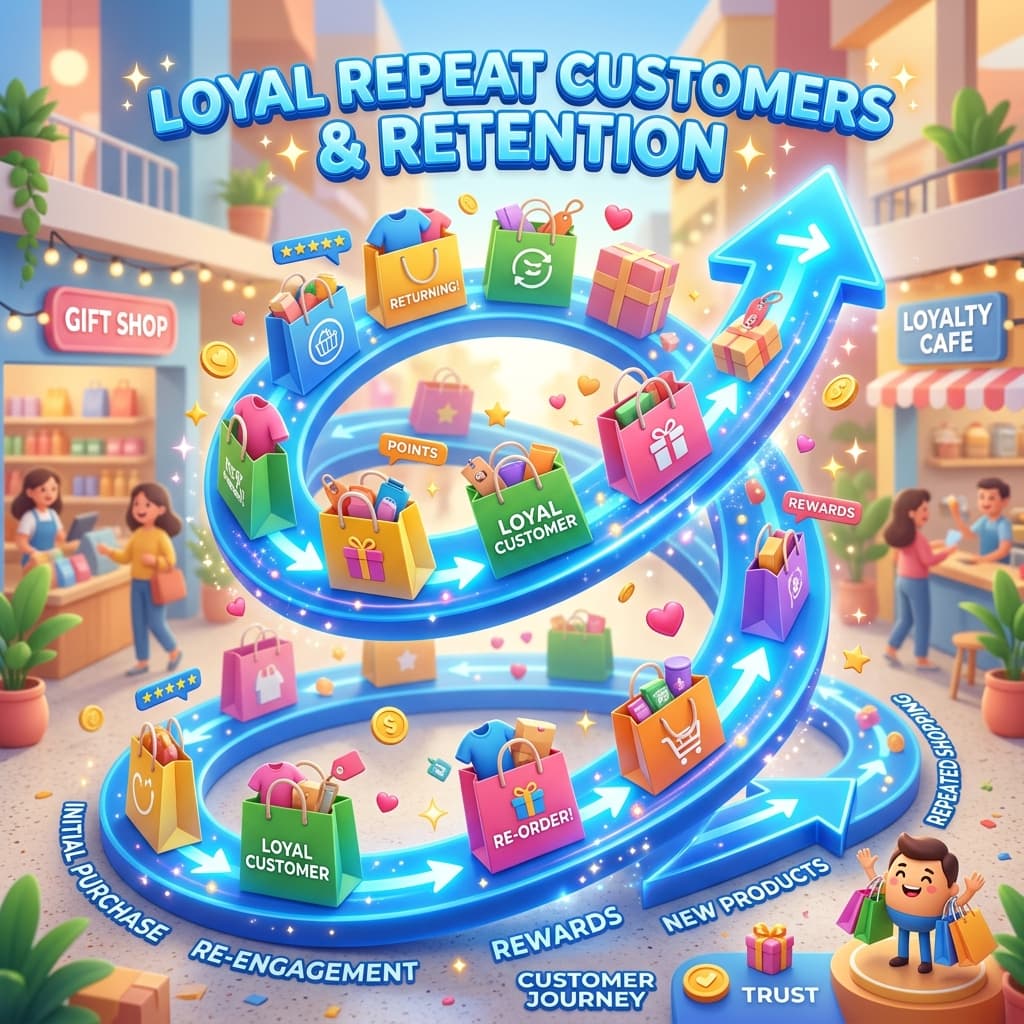
Why Repeat Purchase Rate Is the Metric That Decides Your Profit
Most stores obsess over conversion rate. The smartest stores obsess over repeat purchase rate (RPR) — the percentage of customers who come back for a second purchase.
The math is unforgiving:
- Acquiring a new customer costs 5–7x more than retaining an existing one
- Repeat customers spend 67% more per order on average
- A 5% lift in retention can lift profit by 25–95% (Bain & Co.)
If your RPR is 15% and your competitor's is 30%, they are functionally getting twice the revenue per acquired customer. They can afford to outbid you on every ad auction, every influencer deal, and every keyword. Repeat purchase rate isn't a vanity metric — it's the metric that determines who survives a competitive category.
What Your Repeat Purchase Rate Should Be
Benchmarks vary by category, but here's the rough map:
| Category | Healthy RPR (90 days) |
|---|---|
| Beauty, skincare, cosmetics | 35–55% |
| Supplements, vitamins | 40–60% |
| Coffee, snacks, consumables | 50–70% |
| Apparel & accessories | 20–35% |
| Home goods | 15–25% |
| Furniture, big-ticket | 5–15% (longer cycles) |
| Electronics & gadgets | 10–20% |
If you're significantly below your category benchmark, retention — not acquisition — is the lever that will move your business.
The Repeat Purchase Playbook
Here's the actual playbook, in order of ROI for most stores.
1. Win the second purchase with a post-purchase sequence
The single highest-ROI moment in ecommerce is the 48 hours after a customer's first delivery. The product is in their hands, they're feeling something about it, and they're either going to become a fan or forget you exist.
Build a post-purchase sequence that hits these touchpoints:
- T+0 (order confirmation): Confirm and set expectations
- T+shipped: Tracking + "what's coming"
- T+delivered: "How to get the most out of your [product]" — use, care, tips
- T+3 days after delivery: Review request + complementary product recommendation
- T+14 days: Replenishment reminder (for consumables) or category cross-sell
- T+30 days: "Welcome back" offer with a category they haven't bought yet
For consumables, the replenishment reminder is the single highest-converting message you'll ever send. Time it to 80% of your typical use-up cycle (e.g. day 21 for a 28-day skincare product).
2. Launch a loyalty program (only if you'll actually merchandise it)
Loyalty programs work — but only if customers know they're enrolled and see the points balance often. The mistake: setting up Smile.io, then never mentioning it again.
What actually moves RPR:
- Show the points balance everywhere: header bar, cart, account page, push notifications, email
- Make the first reward easy — 200 points at signup so they cross the "first reward" threshold fast
- Tier the program — "Silver / Gold / Platinum" lifts AOV because customers stretch to hit the next tier
- Pair points with surprise-and-delight — random free gifts on the 3rd order beat predictable discount codes
Stores that use Smile.io, Yotpo Loyalty or Rivo and actively merchandise the program see RPR lifts of 15–30%. Stores that just install it and forget it see almost no lift.
3. Convert one-time buyers to subscribers
For consumables, the highest-leverage RPR move is subscriptions. A customer on a recurring delivery has near-100% RPR by definition.
Tools: Recharge, Skio, Loop Subscriptions.
Tactics that work:
- Default to subscription on the PDP (one-time is the second option, not the first)
- Offer 15% off the first subscription order (cheaper than acquiring a new customer)
- Make pause/skip easy — friction here causes cancellations and bad reviews
- Use subscription milestones (3rd order, 6th order) to send a thank-you gift
Even moving 10–15% of one-time buyers to subscriptions can double your effective RPR.
4. Launch a mobile app — this is the unfair advantage
Customers who install your mobile app have 3–4x higher repeat purchase rates than web-only customers. Across categories. Across geographies. Almost every time we measure it.
Why?
- Your app icon is on their home screen. That's an ad you don't pay for, served hundreds of times per week.
- Push notifications drive engagement. 50–70% open rates vs 15–20% for email. We covered this in Why Push Notifications Are Important.
- One-tap checkout. Saved payment + address removes the cart-page friction that kills repeat purchase.
- No competitor is one search away. When a customer opens your app, they're not getting served a Meta ad for your competitor.
If your category benchmark RPR is 30% and your store is at 22%, building a mobile app on BrewmyApp will close that gap faster than any other single investment.
Start building your mobile app free | See ROI math for an ecommerce mobile app
5. Use push notifications for replenishment, win-back and exclusives
Once your app is live, push notifications carry the bulk of the retention work:
- Replenishment push at 80% of use-up cycle
- Wishlist price-drop push when a saved item goes on sale
- Back-in-stock push for items the customer viewed but didn't buy
- App-exclusive early access for new launches — train customers to open the app for first dibs
- 30/60/90-day win-back push for dormant customers
These campaigns combined typically lift RPR by 10–20% within 90 days of launch.
6. Personalise the home page for return visitors
A returning customer should not see the same hero banner as a first-time visitor. Use Klaviyo + Shopify segmentation (or Rebuy / LimeSpot on the storefront) to:
- Show "Welcome back" headers
- Surface recently viewed and recommended products
- Hide categories they've already bought
- Promote complementary, not repeat, products
Personalised home pages typically lift session conversion 8–15% for returning users.
7. Build a community, not just an audience
The DTC stores with the highest RPRs almost universally have a community — not just an Instagram following. That could be:
- A private Slack/Discord for top customers
- An ambassador program with early access and product co-creation
- An "insiders" email list with content that doesn't appear publicly
- An app with an exclusive content tab (recipes, tutorials, behind-the-scenes)
Community customers don't comparison shop. They buy from you because they're in.
8. Fix the reasons people don't come back
Run a simple post-purchase survey at 30 days for customers who haven't returned: "What stopped you from ordering again?" The top answers are almost always:
- "I forgot about you" → fix with email + push
- "I had an issue and didn't tell you" → fix with proactive support
- "I found a cheaper alternative" → fix with loyalty + bundles
- "I haven't used the first one up yet" → wait for the right replenishment moment
Each of these is fixable. None of them are fatal. But you only know which one is hurting you if you ask.
How to Measure Progress
Track these four metrics monthly:
| Metric | Why it matters |
|---|---|
| Repeat purchase rate (90d) | Headline retention number |
| Customer LTV / CAC ratio | Should be > 3.0 for a healthy DTC business |
| Time between first and second purchase | Shorter = better post-purchase flow |
| Mobile app install rate among new customers | Leading indicator of future RPR |
Track these by acquisition channel — you'll often find that one channel (e.g. influencer-driven first orders) repeats far better than another (e.g. discount-code-driven first orders). Reallocate spend accordingly.
The Compounding Effect
A 1.5x improvement in RPR doesn't just give you 1.5x more revenue from existing customers — it lets you outbid your competitors on acquisition because you can afford a higher CAC. That feeds more first orders, which feed more repeat orders, and so on. Retention compounds in a way acquisition doesn't.
The stores that win in 2026 aren't the ones with the cheapest ads — they're the ones with the highest RPR. Mobile app + push + post-purchase flow + loyalty is the stack that delivers it.
Build your retention stack — start with a mobile app
Related reads:
Ready to Turn Your Store into a Mobile App?
Design and preview your app for free. No coding required.
Start Building for Free