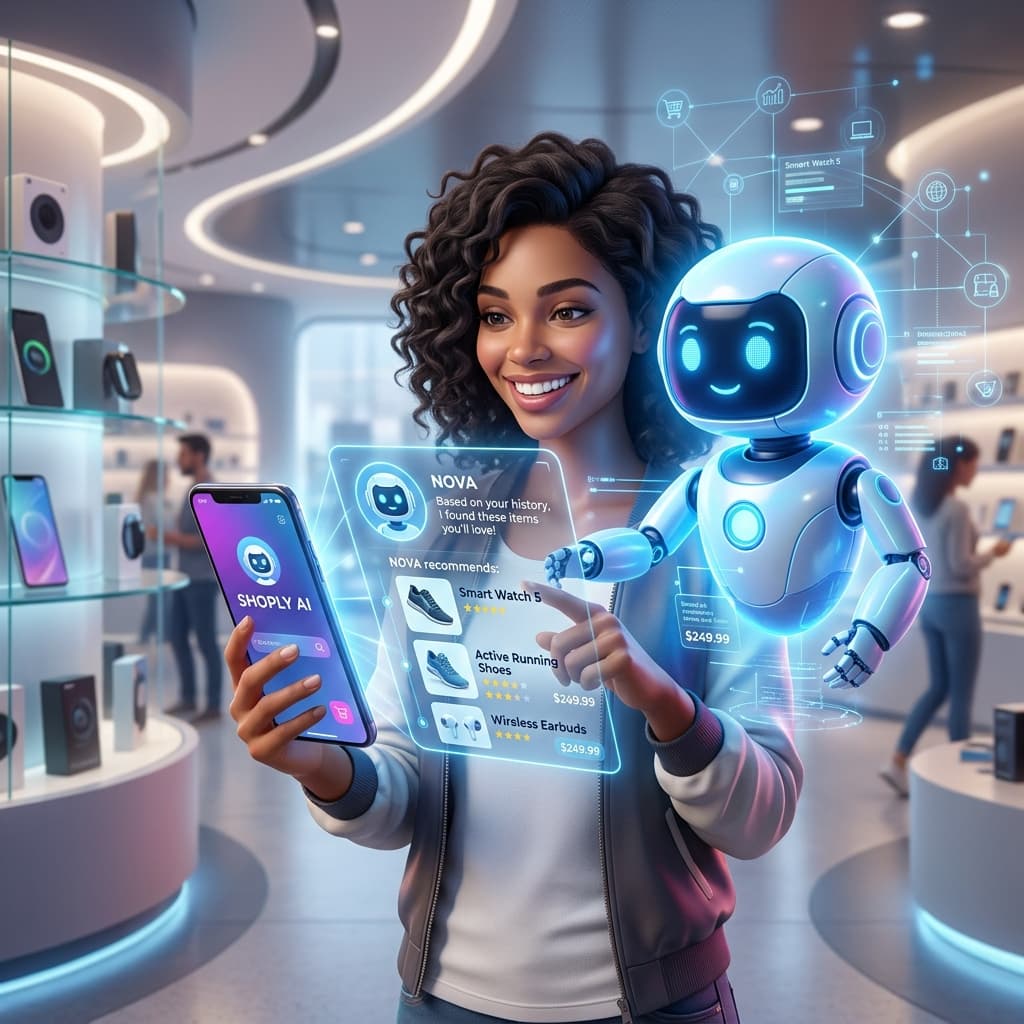
What "Buy with AI" Actually Means in 2026
"Buy with AI" — sometimes called agentic commerce — refers to shopping experiences where a large language model (ChatGPT, Claude, Gemini, Perplexity, Meta AI, etc.) acts on the customer's behalf to find products, compare options, and complete a purchase.
In 2026, three things are happening at once:
- ChatGPT, Claude and Perplexity have launched commerce endpoints that let LLMs surface and transact against Shopify catalogs.
- Shopify's own AI features (semantic search, Sidekick, AI-generated product copy) are now embedded in the merchant admin.
- Conversational selling apps on the storefront let your own customers chat their way to checkout.
If you want your store to be discovered, recommended, and transacted against by AI agents — not just by humans browsing Google — you need to set the right apps up. This guide covers the ones that matter.
Quick Pick by Use Case
| Goal | Top pick |
|---|---|
| Make your catalog discoverable by ChatGPT / Claude / Perplexity | Shopify Catalog + structured data + Searchspring or Algolia |
| On-storefront AI shopping assistant | Rep AI |
| Conversational quiz & product matching | Octane AI |
| AI semantic search on your store | Searchspring Nova or Algolia AI |
| AI product recommendations | Rebuy or LimeSpot |
| AI-powered visual search | ViSenze |
| AI for your mobile app | BrewmyApp (in-app conversational push + deep links) |
1. Shopify Catalog + Native AI Surfaces
Best for: Every Shopify merchant — this is the foundation
Before any third-party app, make sure your catalog is agent-readable: clean product titles, structured attributes (size, colour, material), accurate inventory, and rich product descriptions. Shopify has been pushing merchants to enrich product metadata specifically so AI agents can surface and transact against your catalog through the OpenAI and Anthropic commerce APIs.
What to do:
- Enable Shopify's structured product data fields
- Fill in metafields for material, fit, ingredients, dimensions
- Enable the Shop app integration so your products are visible to ChatGPT's checkout
- Keep inventory feeds accurate — AI agents will deprioritise stores with frequent out-of-stocks
This is foundational work, not an app to install — but you can't skip it.
2. Rep AI — Storefront AI Shopping Assistant
Best for: Stores with complex catalogs where shoppers need guided discovery
Rep AI replaces the static chatbot with a real LLM-backed shopping assistant trained on your catalog. It can recommend products, answer questions about ingredients or sizing, and hand off to a human when needed.
Strengths: trained on your product data automatically, strong on jewellery / apparel / supplements, measurable lift in AOV.
Considerations: pricing scales with conversations. ROI tracking requires careful attribution setup.
3. Octane AI — Conversational Quizzes for Product Matching
Best for: Beauty, supplements, pet, and any category where buyers want a recommendation
Octane AI's quiz builder uses LLMs to generate personalised recommendations from quiz responses. It pairs especially well with Klaviyo — quiz responses become powerful segmentation data for future flows.
Strengths: strong lift on first-purchase conversion, captures zero-party data, integrates with Klaviyo and Recharge.
Considerations: the magic depends on a good quiz — expect to iterate on the flow for a few weeks.
4. Searchspring Nova / Algolia AI Search
Best for: Catalogs with more than 200 SKUs
Default Shopify search is keyword-based. Searchspring Nova and Algolia's AI Search use vector embeddings to understand intent ("a casual dress for a summer wedding under $100") rather than just keywords. Conversion lift on the search results page is typically 10-30%.
Strengths: semantic understanding, typo tolerance, personalised ranking.
Considerations: both are premium tools — overkill for stores under 100 SKUs.
5. Rebuy / LimeSpot — AI Product Recommendations
Best for: AOV lift via cross-sell and upsell
Rebuy and LimeSpot use AI to recommend complementary products on the product page, cart, and post-purchase. They learn from your store's actual purchase patterns rather than relying on category tags.
Strengths: strong attributed revenue, easy to install, works with most themes.
Considerations: can clutter pages if overconfigured — start with one placement.
6. ViSenze — AI Visual Search
Best for: Apparel, home goods, jewellery — categories driven by visual discovery
ViSenze lets shoppers upload an image (or take a photo) and find similar products in your catalog. For apparel and home goods, visual search converts significantly better than keyword search.
Strengths: powerful visual matching, "shop the look" experiences, mobile-first.
Considerations: requires high-quality product imagery. Pricing is enterprise-tier.
7. Shopify Sidekick (Built-in)
Best for: Merchant productivity — not the customer-facing experience
Sidekick is Shopify's built-in AI assistant for merchants — answering admin questions, generating reports, and writing copy. It's free, baked into the admin, and increasingly capable. Use it for daily ops; you still need third-party apps for customer-facing AI.
8. BrewmyApp — AI in Your Mobile App
Best for: Stores who want AI shopping inside their own native app, not just on the web
Web-based AI shopping assistants don't follow your customer into your mobile app — unless you build it on a platform that supports it. BrewmyApp lets you embed your storefront AI experience inside your native mobile app, with deep links to specific products from push notifications and conversational flows.
The bigger picture: when an AI agent transacts with your store on a customer's behalf, you want the customer's next interaction to be in your owned app — not in a chat window where another competing brand is one prompt away. Native apps are how you keep the relationship once the AI handed it to you.
Start building your AI-ready mobile app free | Compare native app vs PWA
How to Prepare Your Shopify Store for AI Agents
Beyond installing apps, there's a checklist every store should run through in 2026:
- Clean product titles — ChatGPT extracts product attributes from titles. "Blue cotton hoodie, men's medium" beats "BLUE HOODIE — STAFF PICK 🔥".
- Fill product metafields — material, dimensions, ingredients, fit. These become filterable attributes for AI agents.
- Accurate inventory feeds — AI agents will skip stores with frequent stock errors.
- Structured FAQs — schema-marked FAQ content gets surfaced in AI answer engines.
- Reviews with substance — long-form reviews give LLMs more context to recommend you.
- Fast page load — agentic crawlers timeout on slow stores just like humans.
- Mobile app with deep links — when the agent completes the purchase, the next touch should land in your app, not a competitor's.
Connecting your store to BrewmyApp
Three ways to connect your store
You do not create an account first. Every route below signs you up and connects the store in the same step.
- From the BrewmyApp homepage. Paste your store URL into the box at the top of brewmyapp.io, approve the install, and you land in the designer with your products already synced.
- From the Shopify App Store. Install BrewmyApp directly from Shopify. The install itself creates your account and links the store — nothing to fill in afterwards.
- From the dashboard. Already have a store connected and want to add another? Add it from your stores page.
Whichever you pick, products, collections, variants, and inventory sync automatically. There is no CSV export and no API key to paste.
BrewmyApp is $49/month or $499/year per store. Designing your app and previewing it on a real device is free — you pay when you build and publish. The app stores charge separately: Apple's Developer Program is $99/year and Google Play is a one-time $25 fee.
The Underrated Risk of AI-Only Commerce
The risk no one talks about: if all your traffic comes through AI agents and Google AI overviews, you don't own the customer relationship. You're a fulfilment node for whichever LLM the customer trusts.
The merchants who win in 2026 will be the ones who use AI to acquire customers and then move them into owned channels — email, SMS, and (most importantly) a mobile app with push notifications they'll actually see.
Build your mobile app to own the customer after the AI agent hands them over.
Related reads:
Ready to Turn Your Store into a Mobile App?
Design and preview your app for free. No coding required.
Start Building for Free