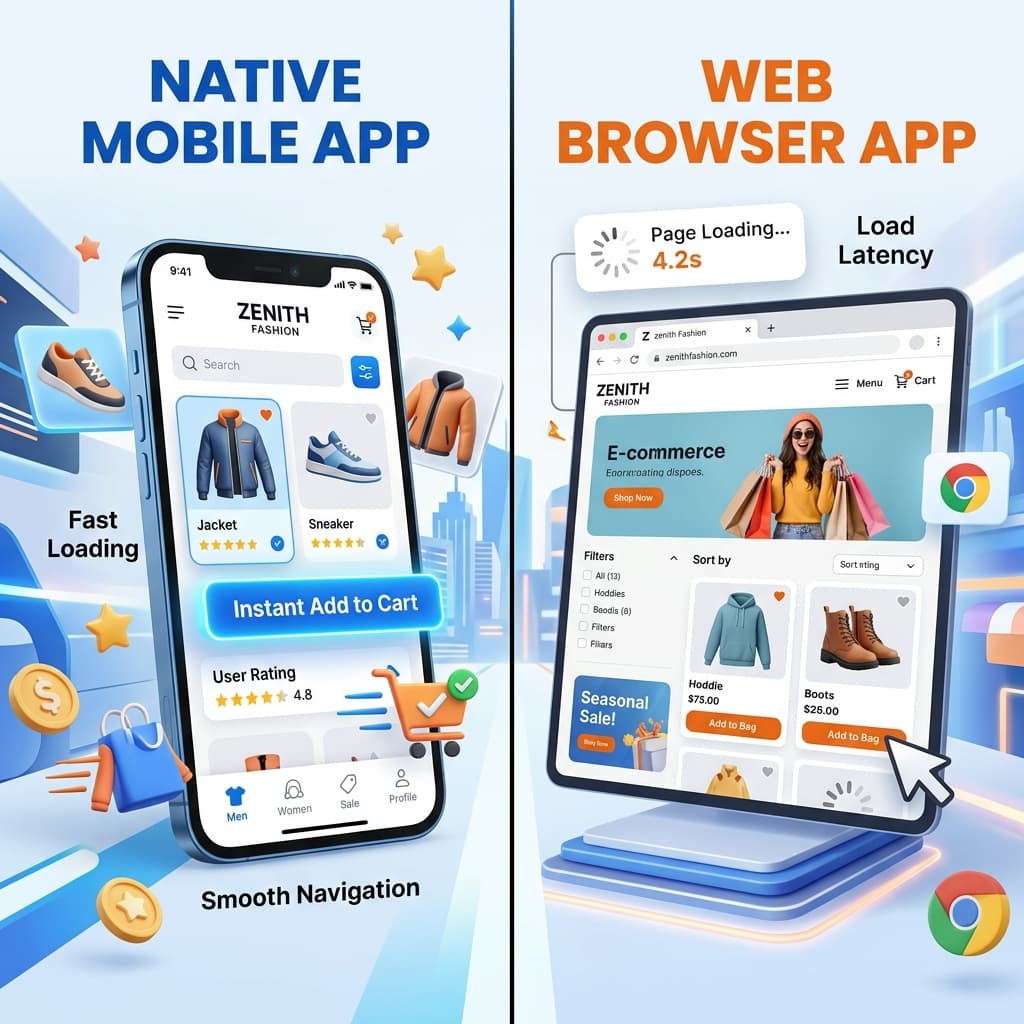
Why This Comparison Matters
Every few years a wave of articles declares that PWAs are about to replace native apps. And every year, the largest ecommerce companies in the world quietly continue to invest heavily in native apps — not PWAs.
This case study compiles the actual numbers from eight brands across two camps:
- The PWA pioneers — Twitter Lite, Pinterest, Starbucks (early PWA bets)
- The native ecommerce winners — Flipkart, Lenskart, Amazon India, Sugar Cosmetics
- The brands that switched — Flipkart and Lenskart both ran PWA experiments before doubling down on native
The conclusion at the end of the data is consistent: for ecommerce specifically, native apps outperform PWAs on the metrics that drive revenue.
Quick Definitions
- Native app: a true iOS/Android app installed from the App Store / Play Store, written in Swift, Kotlin, React Native or Flutter. Full OS access, reliable push, App Store presence.
- PWA (Progressive Web App): a website built with service workers, web app manifest and offline capability that can be "installed" to the home screen and behave like an app. Lives on the web, not in the App Store.
Case 1 — Flipkart: PWA Pioneer to Native Doubling Down
Flipkart built one of the most celebrated PWAs in ecommerce — Flipkart Lite — in 2015. It was cited in every conference talk about the future of mobile commerce.
What actually happened in the years since:
- 2015: Flipkart Lite (PWA) launches with strong initial metrics — 70% lower data usage, 3x time spent vs mobile web
- 2016–2018: Flipkart quietly invests heavily in their native app
- 2019–2026: Flipkart's native app drives ~80% of total revenue; the PWA is a fallback for low-storage devices
- Big Billion Days sales: ~70% of orders come through the native app, not the PWA or web
The headline number Flipkart published internally: native app users had 3.5x higher repeat purchase rate than PWA users with the same first-purchase value.
We covered Flipkart's full mobile playbook in our Flipkart case study.
Case 2 — Lenskart: PWA Experiments, Native Reality
Lenskart's mobile journey followed a similar arc:
- Early PWA bet to reach low-end Android devices in Tier 2/3 India
- Native app rebuilt with deeper try-on AR features (face mapping, virtual frame trials)
- Result by 2024: Native app drives 65–70% of revenue; PWA still exists for catalog browsing but rarely converts
- AR try-on usage — only possible at scale on native. PWAs can't reliably access front camera APIs in the same way
Lenskart's data showed AR try-on users converted at 3x the rate of non-AR users, and AR worked reliably only on native. That alone justified the native investment.
Case 3 — Sugar Cosmetics: Native-First From Day One
Sugar Cosmetics chose to skip the PWA route entirely and went native first. The reasoning was straightforward: cosmetics is a high-retention category where push notifications drive the bulk of repeat revenue, and PWA push is unreliable on iOS.
- 50%+ of total revenue from the native app
- Push notifications drive ~25% of monthly orders
- Average AOV in-app is 20% higher than web
Full Sugar Cosmetics case study.
Case 4 — Twitter Lite (Now X Lite): The PWA Success Story
Twitter Lite is the PWA case study everyone cites — and it's a legitimate success, but in the right context:
- 65% increase in pages per session
- 75% increase in tweets sent
- 20% decrease in bounce rate
What's important: Twitter Lite serves users in markets with expensive data, low-storage devices, and patchy connectivity. The PWA worked because the alternative wasn't "the native app" — it was nothing. Users couldn't afford the native app's storage cost.
Twitter Lite is a PWA win — for a content app, in specific markets, where the native app wasn't a realistic option for that segment.
Case 5 — Pinterest PWA: Discovery Engine, Not Checkout
Pinterest published strong PWA numbers in 2017:
- 60% increase in core engagement
- 44% increase in user-generated ad revenue
- 50% increase in time spent
Pinterest is a discovery / inspiration platform. The PWA worked because users browse Pinterest casually and don't necessarily install another app. But Pinterest still invested heavily in its native app for the monetisable behaviour — saved Pins, push notifications, Shopping Ads.
For a casual discovery app, the PWA was a wedge. For revenue, native still dominated.
Case 6 — Starbucks PWA: Reach, Not Replacement
Starbucks famously launched a PWA in 2017 and announced it had reached parity with the native app on size — 2x smaller, instant load.
What the headlines don't tell you:
- Starbucks still spent years building out its native app and kept investing in native post-PWA launch
- Star Rewards (the loyalty engine that drives 50%+ of US revenue) is primarily a native-app experience — push notifications, mobile order, Apple Pay/Google Pay, biometric login
- The PWA was a reach play (Starbucks needed to reach mobile-web visitors who didn't install the app) — not a native replacement
Starbucks PWA = good wedge for non-installed users. Starbucks native app = the actual revenue engine.
Case 7 — Amazon India: Native All the Way
Amazon India hits a different scale and tells the cleanest version of the story:
- 450M+ registered users
- Native app drives the overwhelming majority of orders
- Prime renewal, miniTV, voice shopping, Pay UPI — all native-exclusive features
- 70%+ of festive season orders come through the native app
Amazon experimented with web-app blends but the product investment has gone into native. The reason: every feature that drives retention (Prime, push, video, biometric checkout) is fundamentally more reliable on native.
Case 8 — Crate & Barrel: Premium Brand, Native Experience
Crate & Barrel's native app focuses on:
- AR room placement (visualize a sofa in your living room)
- Wishlist sync across devices
- Saved cart and addresses for one-tap checkout
- Push for back-in-stock and price drops
AR room placement is the standout — it's technically possible on PWA but real-world adoption is near zero on web. On the native app, it's a primary feature that drives 2x+ conversion on furniture SKUs.
Full Crate & Barrel case study.
The Side-by-Side: What Wins on What
| Metric | PWA | Native app |
|---|---|---|
| Time to first launch | Faster (no install) | Requires install |
| App Store presence | No | Yes |
| Push notifications (iOS) | Limited / unreliable | Reliable, 50–70% open |
| Push notifications (Android) | Possible | Reliable |
| Home screen presence | "Install" is optional | Default |
| Offline browsing | Limited | Full catalog cache |
| Apple Pay / Google Pay | Limited | First-class |
| Biometric login | Limited | First-class |
| AR / camera features | Patchy | Native APIs |
| Data usage | Lower | Slightly higher |
| Distribution | Web only | App Stores |
| Retention (ecom) | Baseline | 3–4x baseline |
| Repeat purchase rate (ecom) | Baseline | 3x baseline |
When PWA Wins
The honest take: PWAs do win in some contexts.
- Content apps with casual usage (news, magazines, blogs)
- Markets with low-end Android and very limited storage
- First-touch reach for users who haven't installed your native app
- Emerging features rolled out faster on web than through App Store review
If you're a content publisher or a social/discovery brand, a PWA is a legitimate option. If you are an ecommerce store, native wins almost universally.
Why Native Wins for Ecommerce Specifically
The factors that drive ecommerce revenue happen to be the factors where native has the biggest gap over PWA:
- Push notifications — the #1 retention channel, and iOS push for PWAs is still unreliable as of 2026
- One-tap checkout with Apple Pay / Google Pay, saved cards, biometrics
- Home screen presence — your icon is a free ad served hundreds of times a week
- App Store discovery — billions of searches, organic installs, ratings as a trust signal
- Reliable deep linking from emails, ads and influencer links
- OS integration — App Clips, Siri Shortcuts, Live Activities, widgets
Each of these factors moves repeat purchase rate. Add them up and the gap between native and PWA isn't small — it's structural.
What This Means for Your Store
If you're an ecommerce store building your first mobile presence:
- If you sell repeat-purchase products (beauty, food, supplements, fashion, electronics) — go native.
- If you're in a market with very low-end devices as your primary segment — start PWA, plan to add native.
- If you don't have an in-house dev team — use BrewmyApp to build a true React Native app without writing code.
Start your native app for free | Build a PWA for your store (we'll help via email)
Related reads:
Ready to Turn Your Store into a Mobile App?
Design and preview your app for free. No coding required.
Start Building for Free