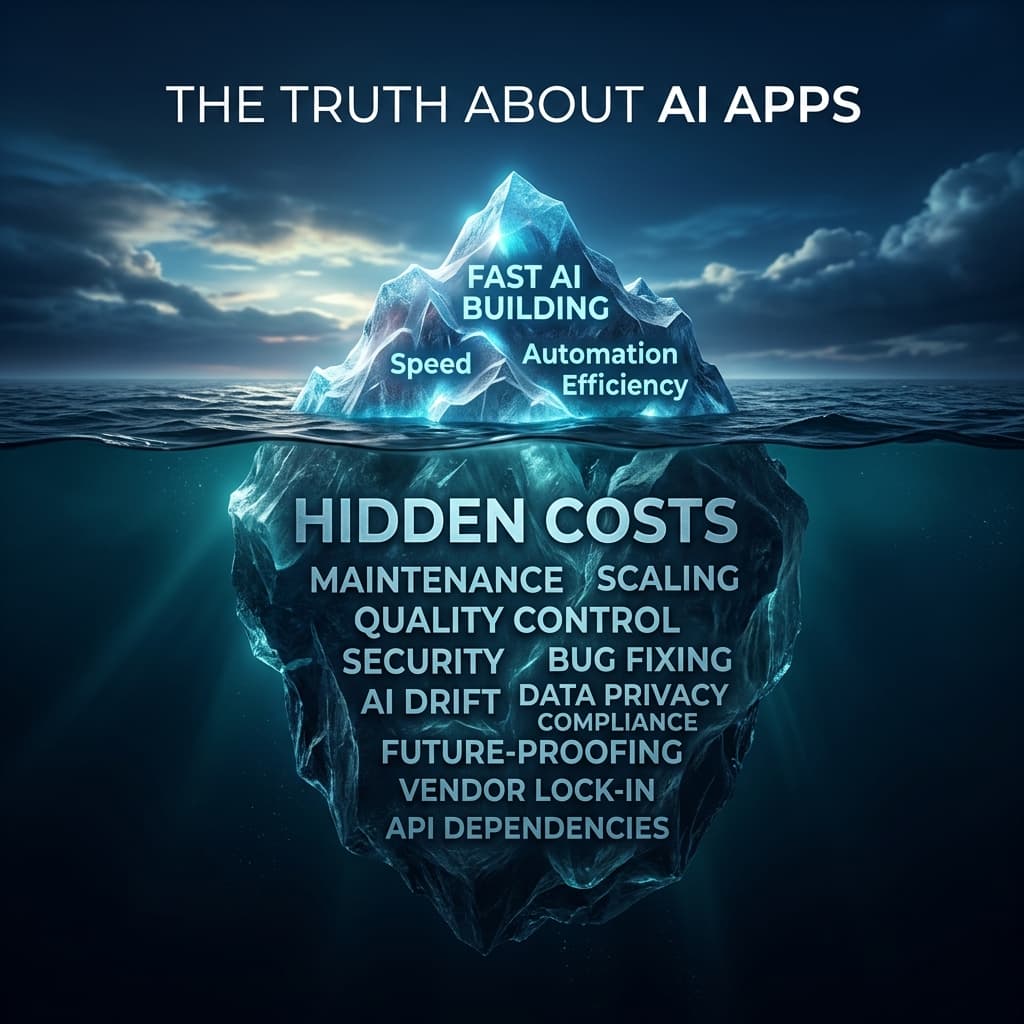
The Hidden Cost Problem in AI-Only App Development
Updated April 27, 2026: This guide now includes a lifecycle cost model for ecommerce apps covering build, release, maintenance, and growth operations.
AI tools can reduce initial coding time. That part is true.
What many teams miss is that app success is not measured at prototype stage. It is measured after production launch, when stability, sync quality, checkout reliability, and release discipline start affecting revenue.
That is where hidden costs emerge.
1. Rework from Unstable Architecture
AI can generate working fragments quickly, but architecture consistency often degrades across features.
Typical impact:
- Repeated refactors
- Inconsistent data handling
- Edge-case bugs in cart/checkout/account flows
Business cost: launch delays and developer rework cycles.
2. Security and Compliance Hardening
AI-generated code rarely ships with production-grade security by default.
Typical impact:
- Credential exposure risk
- Weak auth flows
- Incomplete input validation
- Policy issues during app review
Business cost: security reviews, fixes, and delayed publishing.
3. App Store Submission Overhead
Many teams underestimate release operations.
Typical impact:
- Signing/certificate complexity
- Repeated store review rejections
- Metadata/screenshot inconsistencies
- Build config failures
Business cost: slower time-to-market and missed campaign windows.
4. Maintenance Debt After Launch
AI helps write code once. It does not eliminate maintenance.
Typical impact:
- Dependency updates and breakage
- OS version compatibility fixes
- Regression QA on every release
- Feature interaction bugs over time
Business cost: ongoing engineering load and unpredictable monthly effort.
5. Conversion Loss from Reliability Gaps
Even small reliability issues can hit ecommerce metrics.
Typical impact:
- Broken variant selection
- Coupon/price mismatch
- Inventory drift
- Checkout friction
Business cost: lost orders, higher abandonment, lower LTV.
Cost Layers Most Teams Ignore
When calculating AI-only development cost, include:
- Engineering hours for rework
- QA and release cycles
- Incident response and bug triage
- Ongoing maintenance commitment
- Revenue impact from app instability
Without this, ROI comparisons are incomplete.
AI-Only vs Managed Builder Cost Profile
| Layer | AI-Only Path | BrewmyApp Path |
|---|---|---|
| Initial build | Lower for prototype | Predictable production path |
| Release process | More manual overhead | Guided and repeatable |
| Maintenance | Higher owner burden | Lower operational load |
| Ecommerce sync | Custom responsibility | Managed integration workflows |
| Time to reliable scale | Longer in many cases | Typically faster |
Practical Recommendation
If you have a strong in-house mobile team and want full stack ownership, AI-first can work.
If your priority is business outcomes with lower engineering overhead, a managed no-code approach is usually more cost-efficient over 6-24 months.
You can evaluate quickly with:
Final Takeaway
AI is a powerful accelerator, but not a free replacement for production operations.
For most ecommerce brands, the hidden costs of AI-only paths appear after launch. Plan for lifecycle cost, not just development speed.
Related reads:
Ready to Turn Your Store into a Mobile App?
Design and preview your app for free. No coding required.
Start Building for Free