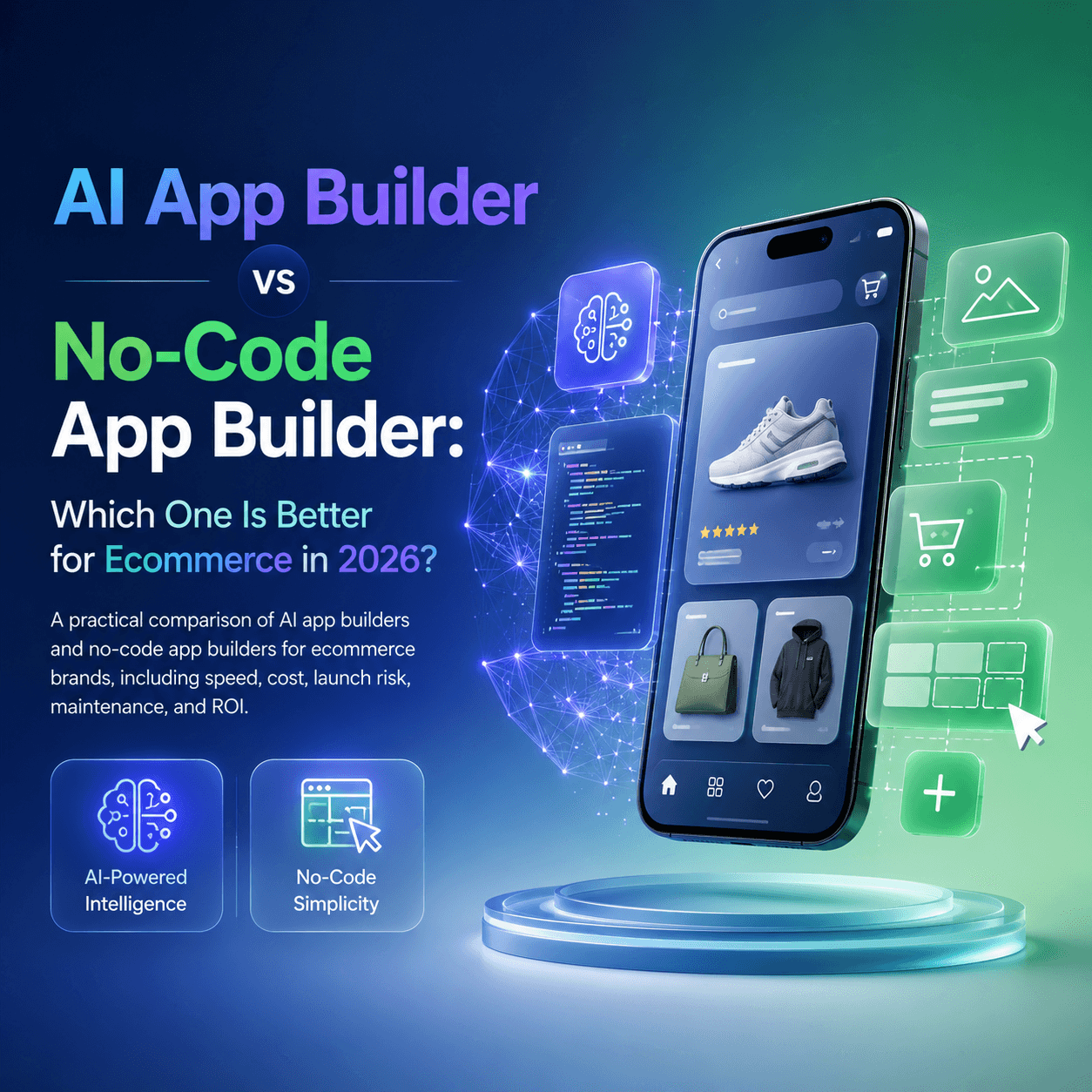
AI App Builder vs No-Code App Builder: What Is the Real Difference?
Updated April 27, 2026: This comparison focuses on real ecommerce execution, not demos: launch reliability, operating cost, and long-term maintenance.
Both categories promise faster app delivery than traditional development. But they solve different problems.
- AI app builder workflows usually generate code or app logic with prompt-driven assistance.
- No-code app builders provide managed visual workflows and production-ready pipelines without requiring coding.
If you run a WooCommerce or Shopify store, the key question is not which one sounds smarter. The key question is which one gets your app shipped and maintained with less risk.
Side-by-Side Comparison
| Factor | AI App Builder | No-Code App Builder (BrewmyApp) |
|---|---|---|
| Setup speed | Fast for prototypes | Fast for production preview |
| Technical dependency | Medium to high | Low |
| Build/release complexity | Usually manual or semi-manual | Guided workflow |
| App-store readiness | Variable | Predictable |
| Ecommerce sync reliability | Depends on custom implementation | Built-in integration model |
| Maintenance overhead | Higher | Lower |
| Best for | Technical product teams | Store owners, agencies, growth teams |
Where AI Builders Win
AI-based workflows are great for:
- Rapid concept validation
- Highly custom UI experiments
- Teams with in-house engineering capacity
- Custom feature roadmaps requiring code ownership
If you already run a technical team, AI can accelerate your dev cycle.
Where No-Code Builders Win
No-code builders like BrewmyApp win when:
- You need launch speed without coding bottlenecks
- You need stable WooCommerce/Shopify sync
- You want less operational burden after launch
- You care about speed-to-revenue over infrastructure management
For most ecommerce operators, this is the more practical path.
Cost Reality: Which Is Cheaper?
AI often appears cheaper at the start. But total cost changes when you include:
- Debugging cycles
- App store submission rework
- Release process complexity
- Ongoing maintenance and compatibility updates
No-code pricing is usually easier to predict, while AI-first paths can have wider cost variance depending on technical debt and team capability.
See current BrewmyApp pricing and compare against your expected engineering effort.
Decision Framework
Choose AI app builder if:
- You need deep custom logic.
- You have engineers for long-term ownership.
- You are ready to manage release operations.
Choose no-code app builder if:
- You need faster go-live with lower technical risk.
- You want visual control with production reliability.
- You prefer operational simplicity after launch.
Hybrid Model: AI + BrewmyApp
The strongest strategy for many teams is hybrid:
- Use BrewmyApp for core app foundation and release operations
- Use AI for copy, campaigns, support docs, and experimentation
This gives you speed and stability at the same time.
Final Verdict
For most ecommerce brands, no-code builders outperform AI-only builders in practical delivery and lifecycle reliability.
If your goal is launching native apps quickly for business outcomes, start with:
Related reads:
Ready to Turn Your Store into a Mobile App?
Design and preview your app for free. No coding required.
Start Building for Free