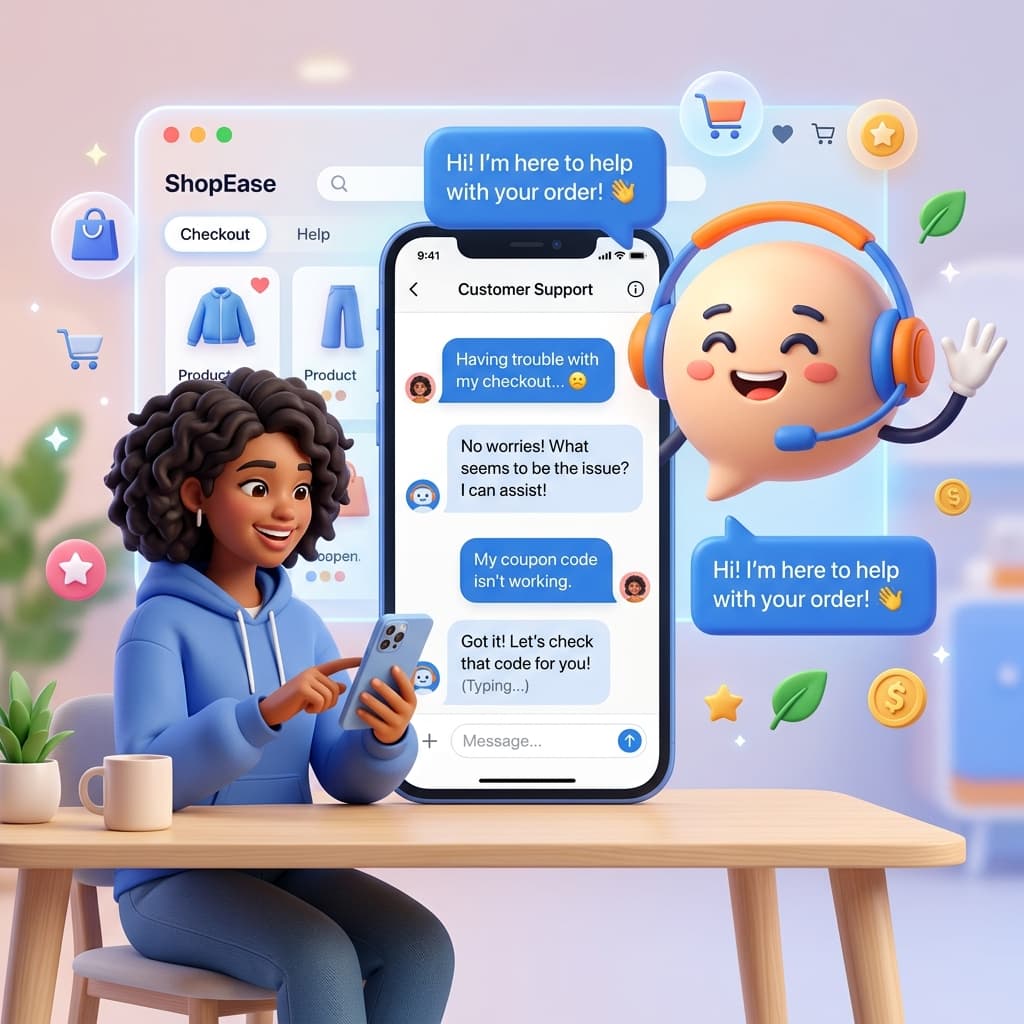
Why Live Chat Punches Above Its Weight
Live chat is the most cost-effective conversion tool most ecommerce stores ignore. Visitors who engage with chat convert at 3 to 5 times the rate of visitors who don't, and the customers who use chat spend roughly 15 percent more per order.
Why? Because most cart abandonment isn't really about price — it's about unanswered questions. "Will this fit?" "When will it arrive?" "Can I return it?" If those questions go unanswered for 30 seconds, the shopper closes the tab. If they get a confident answer in 10 seconds, they check out.
The Business Impact, In Numbers
Aggregated across published case studies and platform benchmarks:
| Metric | Without live chat | With live chat |
|---|---|---|
| Conversion rate of engaged visitors | 2–3% | 8–15% |
| Average order value | Baseline | +10–15% |
| Customer satisfaction (CSAT) | 70–80% | 85–92% |
| Repeat purchase rate | Baseline | +20–25% |
| Support ticket volume | Higher | Lower (deflected at point of question) |
For a store doing $50k/month, even a modest 10% conversion lift on chat-engaged visitors typically returns 8 to 15x what you spend on the chat platform.
Where Live Chat Moves the Needle
1. Pre-purchase question deflection
The single most common chat use case: "Does this come in size XL?" "Is this in stock in blue?" "When will my order arrive in Australia?" Answering these in real time prevents the shopper from leaving to "check later" — which usually means never coming back.
2. Cart abandonment recovery (proactive chat)
Trigger a chat invitation when a visitor lingers on checkout for more than 60 seconds or hovers over the close button. A well-timed "Need help completing your order?" recovers 10 to 20 percent of would-be abandoners.
3. Sizing, fit and product fit guidance
Apparel, cosmetics, supplements — any category with a fit/dose/match question — sees the biggest lift. A human (or well-trained AI) reduces post-purchase return rates by helping the customer pick the right variant up front.
4. Order status and "where is my order"
Roughly 30 to 50 percent of ecommerce support volume is "WISMO" (where is my order). Letting chat answer this — with a tracking lookup or AI bot connected to your shipping data — reclaims hours of human agent time per week.
5. Building relationships that drive repeat purchase
Chat conversations often surface customer preferences (sizing, allergies, favourite colours) that you can store and use to personalise future marketing. The post-purchase follow-up "How did the shoes work out?" message has unreasonably good open rates and re-engagement.
AI vs Human vs Hybrid
The right setup in 2026 is almost always hybrid:
- AI handles the top 70–80% of repetitive questions instantly: shipping, returns, stock, order status, FAQs.
- AI escalates to a human when it detects intent it can't handle, frustration, complex requests, or high-value carts.
- Humans focus on edge cases, complex orders, complaints, and VIP customers.
Pure AI alone frustrates customers on anything emotional or non-standard. Pure human-only chat doesn't scale past a few hundred conversations a day without ballooning headcount. The hybrid model captures the cost benefits of AI without the customer experience cost.
Popular Live Chat Tools
| Tool | Best for | Notes |
|---|---|---|
| Shopify Inbox | Stores getting started | Free, native to Shopify, basic but functional |
| Tidio | Small/mid stores | Strong AI bots, fair pricing, easy setup |
| Gorgias | High-volume support teams | Best Shopify-native helpdesk + chat |
| Zendesk | Larger brands | Robust ticketing, more expensive |
| Intercom | SaaS-style merchants | Advanced automation, premium pricing |
| Tawk.to | Cost-conscious stores | Free, but ads/branded by default |
| WhatsApp Business | Markets where WhatsApp dominates | See our WhatsApp support guide |
Live Chat in Your Mobile App
Here's what almost no one talks about: web-based live chat doesn't follow your customer into your mobile app. If you have an app and a chat widget on your website, your app users are silently underserved.
When you build your mobile app on BrewmyApp, you can integrate in-app messaging and connect it to your existing chat platform (Tidio, Gorgias, etc.) so app users get the same support experience as web users — but with the bonus of push notifications when an agent replies. That eliminates the "did anyone get back to me?" friction that kills async chat conversations.
For markets where WhatsApp is the dominant messaging channel (India, Brazil, the Middle East, much of Southeast Asia), embedding a "Chat on WhatsApp" button in your mobile app is one of the highest-converting CTAs available.
Setting Up Live Chat the Right Way
A short checklist for stores rolling chat out for the first time:
- Don't be available 24/7 unless you actually are. A chat widget that says "We're online" while no one responds is worse than no chat at all. Use AI for off-hours.
- Train your AI on real questions. Feed it your actual past support tickets and FAQs, not a generic intent library.
- Set proactive triggers carefully. Pop-up chats on landing are annoying. Time-on-page > 45 seconds or cart-page-stalled triggers convert.
- Track conversion of chat-engaged visitors. This is the metric that justifies the spend.
- Make handoff invisible. When AI escalates to a human, pass the conversation history so the customer doesn't repeat themselves.
- Extend chat into your mobile app. Don't leave app users on a different support pathway.
The Compounding Effect
The often-missed benefit of live chat: every conversation is a free piece of customer research. Patterns in your chat logs tell you:
- Which product attributes shoppers don't trust your descriptions on (fix the PDP)
- Which sizes/variants get questioned most often (fix the size guide)
- Which shipping destinations create the most friction (fix the policy page)
- Which products draw repeat questions about quality (rewrite the listing)
Stores that read their chat transcripts every week compound the value far beyond the immediate conversion lift.
Connecting your store to BrewmyApp
Three ways to connect your store
You do not create an account first. Every route below signs you up and connects the store in the same step.
- From the BrewmyApp homepage. Paste your store URL into the box at the top of brewmyapp.io, approve the install, and you land in the designer with your products already synced.
- From the Shopify App Store. Install BrewmyApp directly from Shopify. The install itself creates your account and links the store — nothing to fill in afterwards.
- From the dashboard. Already have a store connected and want to add another? Add it from your stores page.
Whichever you pick, products, collections, variants, and inventory sync automatically. There is no CSV export and no API key to paste.
BrewmyApp is $49/month or $499/year per store. Designing your app and previewing it on a real device is free — you pay when you build and publish. The app stores charge separately: Apple's Developer Program is $99/year and Google Play is a one-time $25 fee.
Get Started
If you don't have live chat yet, start with Shopify Inbox or Tidio — both have generous free tiers. If you already have chat on the web, your next move is to extend it into your mobile app so app customers get the same service.
Build your mobile app with in-app messaging support | See how push notifications keep chat conversations alive
Related reads:
Ready to Turn Your Store into a Mobile App?
Design and preview your app for free. No coding required.
Start Building for Free