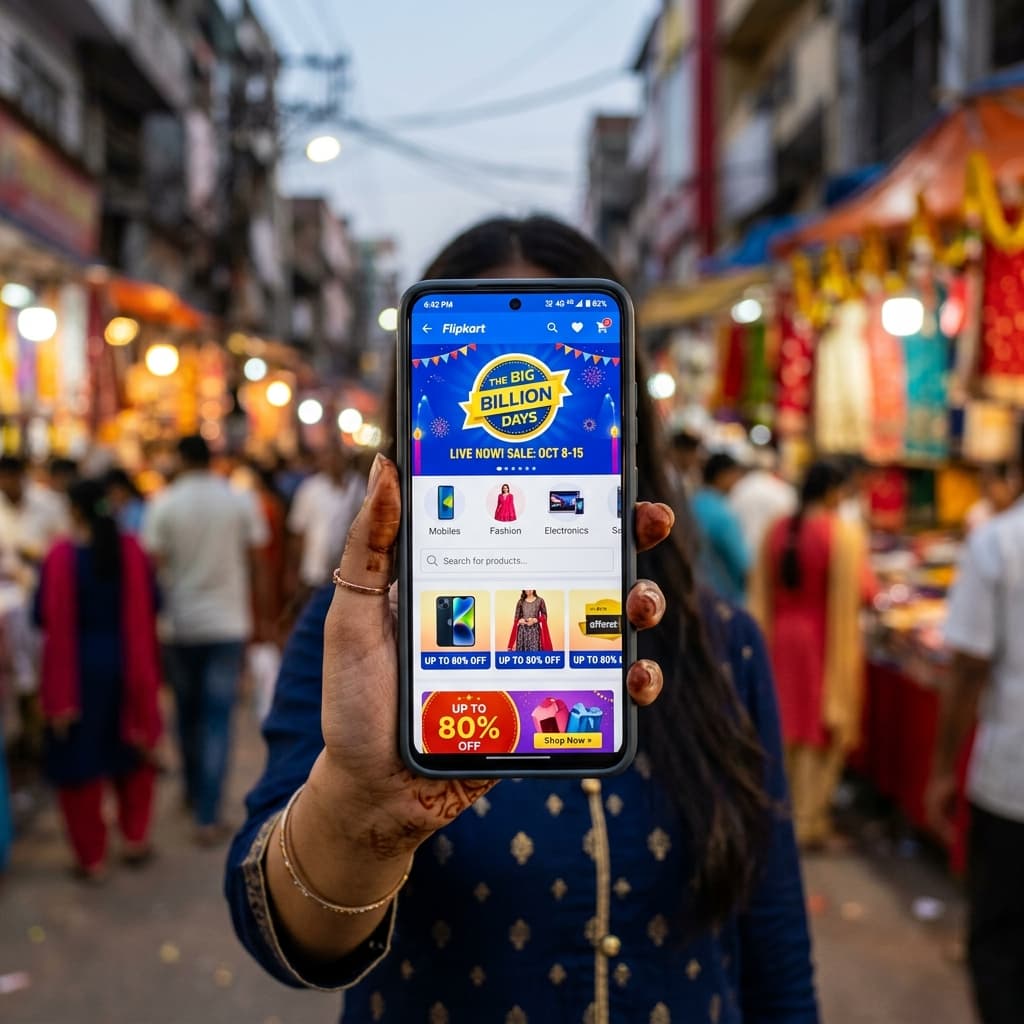
From a Bangalore Apartment to India's E-Commerce Throne
In October 2007, two former Amazon engineers named Sachin Bansal and Binny Bansal (no relation) started an online bookstore from a small apartment in Koramangala, Bangalore, with just ₹4,00,000 (~$4,764) in seed money. They couldn't have imagined that, less than two decades later, Flipkart would command 47% of India's e-commerce market, serve 450 million+ registered users, and process 5.5 million orders every single day.
This isn't just a story about a successful Indian startup. It's a case study in how a mobile-first strategy, paired with deep vernacular localization and technology bets that nobody else dared to make, can unlock the next billion users.
The Pivot: Going All-In on Mobile (and Briefly, App-Only)
By 2014, Flipkart's leadership saw what no one in Western e-commerce wanted to admit: in India, the mobile app wasn't a companion to the website — it was the only experience that mattered. Most first-time internet users in India were never going to own a PC. Their first (and only) computer was a sub-$100 Android phone.
In 2015, Flipkart made a famously aggressive bet: it shut down its mobile website entirely to push users into the native app. The strategy worked for engagement but alienated low-end Android users on flaky 2G networks.
The fix became one of the most-cited mobile case studies of the decade.
Flipkart Lite: The PWA That Rewrote the Playbook
Rather than abandon the mobile web, Flipkart's engineering team built Flipkart Lite — a Progressive Web App (PWA) that loaded instantly, worked offline, and could be "installed" to the home screen without going through an app store. Google later showcased the results on web.dev:
| Metric | Result |
|---|---|
| Conversion rate vs. old mobile site | +70% |
| Time on site | 3.5 min (up from 70 sec) |
| Visits launched from home-screen icon | 60% of all visits |
| Data usage vs. native app | 3x less |
| Engagement lift (Add-to-Home-Screen + offline) | +40% |
The kicker? 63% of Flipkart Lite users were on 2G connections. The team used service workers, route-based code-splitting, and skeleton screens to make the experience feel instant even on the slowest networks.
Lesson for ecommerce builders: Don't think of "app vs. web" as a binary. The fastest-growing markets need both — a beautiful native app for power users and a featherweight web experience for the next billion.
The Vernacular Bet: 11 Languages, Tier 2/3 First
While most e-commerce founders chased Bangalore and Mumbai's English-speaking professionals, Flipkart looked at the map differently. Today, over 50% of Flipkart's customers come from Tier 2 and Tier 3 cities, and Tier 3+ growth has run at 47% year-over-year.
The app now ships with 11 Indian-language interfaces — Hindi, Tamil, Telugu, Bengali, Marathi, Kannada and more — with full voice-search support in regional dialects. The impact:
- Indian-language users on Flipkart grew from 12% (Q4 2020) to 18% (Q4 2021), with usage doubling in a single year.
- 95% of users who switched to a regional language interface kept using it — the stickiest cohort on the platform.
- A first-time shopper in Tier 3 India can now speak their search query in Bhojpuri-accented Hindi and have Flipkart understand it.
This is the part most "global" e-commerce playbooks miss entirely: language is infrastructure.
Big Billion Days: The App-First Festival That Ate Indian Diwali
Launched in 2014, Big Billion Days (BBD) is Flipkart's annual mega-sale built around India's festive season. It's now the single largest e-commerce event in the country.
- BBD 2024: 282 million event visitors.
- BBD 2025: During Early Access, Flipkart Minutes (the company's quick-commerce vertical) saw 4.5M unique visitors and doubled its daily order volume. The fastest recorded iPhone delivery clocked in at under 3 minutes from order to doorstep.
- Premium carts touched ₹1.57 lakh, while the same platform shipped dry fruits, medicines, and groceries to small towns.
BBD works because the app is built for it: real-time inventory, in-app live notifications, lightweight product cards, EMI/UPI checkout in two taps, and a recommendation engine that learns from every swipe.
The Walmart Chapter: From Bootstrap to $16B Exit
On May 9, 2018, Walmart announced its acquisition of a 77% controlling stake in Flipkart for $16 billion — at the time, the largest e-commerce acquisition in history. The deal closed on August 18, 2018.
- Co-founder Sachin Bansal sold his 5.5% stake, exited, and went on to found Navi Group.
- Co-founder Binny Bansal stayed on as Group CEO until late 2018; he formally left the Flipkart board in January 2024.
The Walmart capital was the rocket fuel for everything that followed: Flipkart Minutes (quick commerce), Shopsy (social commerce for Tier 3+), grocery infrastructure, regional fulfillment centers, and the vernacular AI stack.
The Numbers Today
| Metric | 2026 |
|---|---|
| Registered users | 450M+ |
| Monthly active users | 180M (~40% of registered base) |
| Daily orders | 5.5M |
| Market share (Indian e-commerce) | ~47% |
| FY 2025 revenue | ₹82,350 Cr (~$9.8B) |
| Languages supported | 11 Indian languages |
| Tier 2/3 share of users | 50%+ |
What Ecommerce Founders Can Steal from Flipkart's Playbook
You don't need a $16B exit to apply Flipkart's principles. Here are the four lessons that translate to any direct-to-consumer brand:
1. Mobile-First, Not Mobile-Also
The desktop website is a secondary channel for most growing markets. Design your checkout, navigation, and product pages for a one-handed scroll on a 5.5" screen first — and let everything else inherit from that.
2. Build for the Worst Network, Not the Best One
Flipkart's PWA assumed 2G. Your customers in Tier 3 India, rural Indonesia, or small-town Brazil are on the same. Lazy-load images, ship a service worker, cache the catalog, and let people browse offline.
3. Localize Beyond Translation
A "Hindi version" of an English app isn't localization. Voice search in regional dialects, festive-themed UI, India-specific payment rails (UPI, COD, EMI), and culturally relevant product imagery are what actually moved Flipkart's needle.
4. Make the App the Whole Brand
Push notifications, gamified sales events, in-app live streams, and personalized recommendations turn a transactional app into a destination. Flipkart users open the app out of habit, not just intent.
Try the Flipkart App
See Flipkart's mobile experience for yourself:
- Web: flipkart.com
- Android: Flipkart on Google Play
- iOS: Flipkart on the App Store
Build Your Own Mobile-First Ecommerce Brand
You can't out-spend Walmart on quick commerce — but you can apply the same principles to your store. With BrewmyApp, any Shopify or WooCommerce merchant can ship a native iOS + Android app with the same mobile-first DNA that powers Flipkart: push notifications, vernacular support, lightning-fast product pages, and a checkout designed for the next billion users.
Ready to Turn Your Store into a Mobile App?
Design and preview your app for free. No coding required.
Start Building for Free