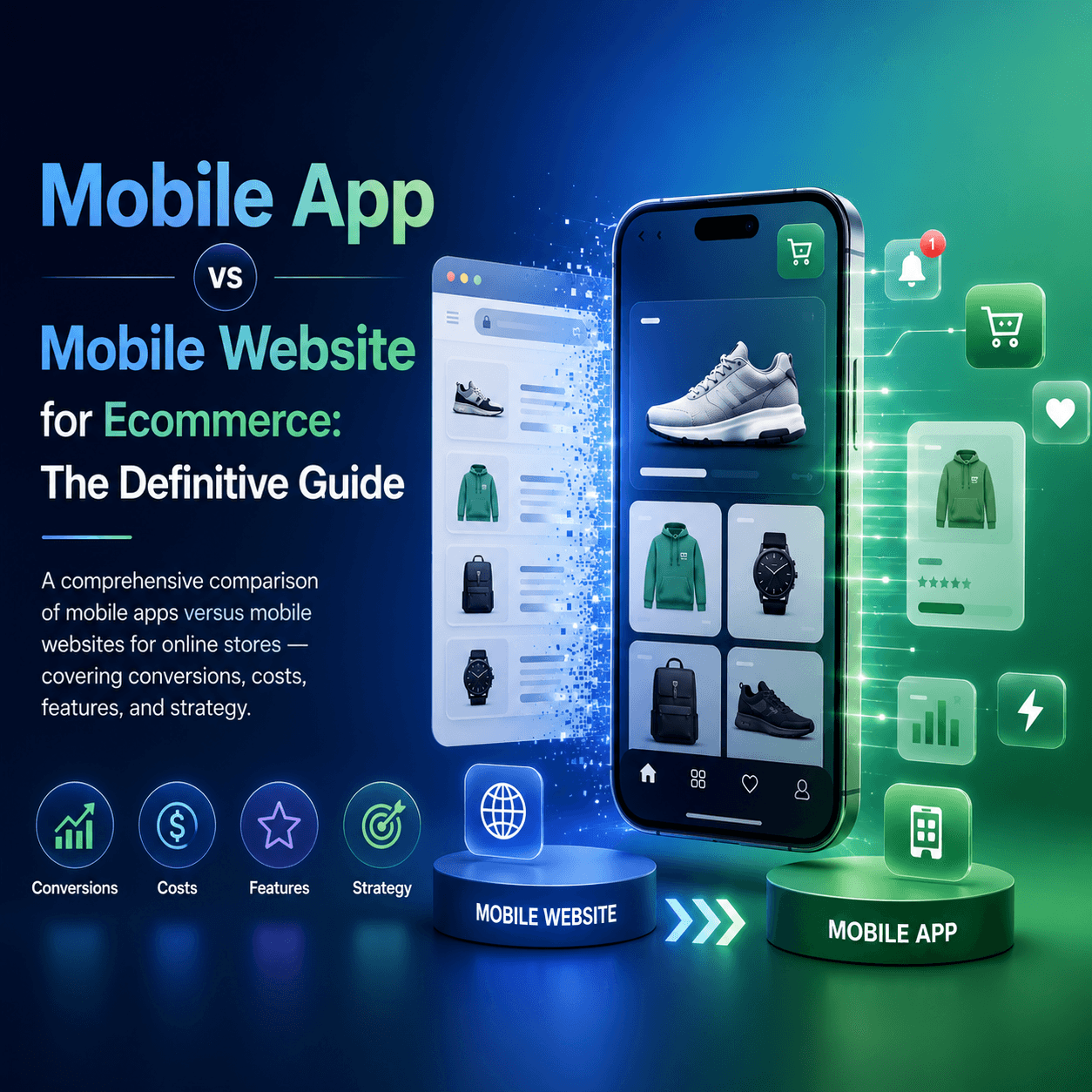
The Mobile Commerce Landscape in 2026
Mobile commerce now accounts for over 72 percent of all ecommerce transactions globally. By 2027, mobile sales are projected to exceed 5 trillion dollars worldwide. Every ecommerce business needs a mobile strategy — but the question of whether to invest in a mobile app, a responsive mobile website, or both deserves careful analysis.
This guide provides a comprehensive, data-driven comparison to help you make the right investment decision for your online store.
What Is a Mobile Website?
A mobile website (or responsive website) is your regular website optimized to display correctly on mobile screens. When a customer visits your URL on their phone's browser, the same website adapts its layout to fit the smaller screen.
How It Works
Modern responsive websites use CSS media queries and flexible layouts to adjust content presentation based on screen size. The same HTML, CSS, and JavaScript serve both desktop and mobile visitors. The server detects the device and delivers the appropriate layout.
Strengths of Mobile Websites
- Universal access — Works on any device with a web browser
- SEO and discoverability — Google indexes and ranks your website, driving organic traffic
- Zero friction for new visitors — No download required, customers can browse instantly from search results or social media links
- Single codebase — One website serves all devices, simplifying maintenance
- Lower development cost — Your website already exists, and making it responsive is standard practice
- Instant updates — Changes deploy immediately to all visitors
Limitations of Mobile Websites
- Lower conversion rates — Average 1.5 to 2 percent versus 4 to 6 percent for apps
- No push notifications — Web push exists but has very limited reach and engagement compared to native push
- Session dependency — Cart and user state can be lost when the browser session ends
- Slower experience — Every page requires a network request and full render
- No home screen presence — No persistent brand reminder on the customer's device
- Limited device features — Cannot access camera, biometrics, or other native capabilities effectively
What Is a Mobile App?
A native mobile app is a standalone application installed from the App Store or Google Play that runs directly on the customer's device.
How It Works
The app is downloaded and installed on the customer's phone. It connects to your store's backend (WooCommerce or Shopify) through APIs to display products, process orders, and manage customer data. The app runs using native device capabilities, providing a faster and more integrated experience than a website.
Strengths of Mobile Apps
- Higher conversion rates — 4 to 6 percent average, three times better than mobile web
- Push notifications — Direct, free, instant communication with 50 to 70 percent open rates
- Persistent presence — App icon on the home screen is a constant brand reminder
- Superior performance — Faster load times, smoother animations, instant transitions
- Saved payment methods — One-tap checkout with Apple Pay, Google Pay, and saved cards
- Offline capability — Browse products and view cart without internet connection
- Lower cart abandonment — 20 percent versus 85 percent on mobile web
- Higher customer lifetime value — App users spend three to four times more over their lifetime
Limitations of Mobile Apps
- Download barrier — Customers must install the app, which is an extra step
- Development cost — Requires investment in an app builder or development team
- Platform compliance — Must meet Apple and Google guidelines for approval
- Not indexed by search engines — App content is not discoverable through Google search
- Storage space — Takes up space on the customer's device
Performance Comparison
Conversion Rate
| Channel | Average Conversion Rate |
|---|---|
| Desktop website | 3 to 4 percent |
| Mobile website | 1.5 to 2 percent |
| Mobile app | 4 to 6 percent |
The conversion gap between mobile websites and apps is the most compelling data point. Apps convert three times better because they eliminate the friction points that cause mobile web abandonment.
Cart Abandonment
| Channel | Cart Abandonment Rate |
|---|---|
| Desktop website | 70 percent |
| Mobile website | 85 percent |
| Mobile app | 20 percent |
Mobile web cart abandonment is catastrophically high. The combination of slow checkouts, manual form filling, and session instability means 85 out of 100 customers who add items to their cart never complete the purchase. Apps solve this comprehensively through saved payments, persistent carts, and streamlined checkout.
Session Duration
| Channel | Average Session Duration |
|---|---|
| Mobile website | 2 to 3 minutes |
| Mobile app | 5 to 8 minutes |
Longer sessions mean more products viewed, more items added to cart, and higher average order values. Apps keep customers engaged through faster navigation and a more immersive experience.
Customer Retention (30-Day Return Rate)
| Channel | 30-Day Return Rate |
|---|---|
| Mobile website | 10 to 15 percent |
| Mobile app | 40 to 60 percent |
Apps retain three to four times more customers because the home screen icon creates habitual behavior. Combined with push notifications that bring customers back for promotions and new products, apps become a retention engine.
Cost Comparison
Mobile Website
- Already included with most ecommerce platforms (WooCommerce, Shopify)
- Hosting: 20 to 200 dollars per month
- Theme or design: 0 to 5,000 dollars (one-time)
- Ongoing maintenance: Minimal — standard website operations
Mobile App (No-Code Builder)
- Monthly subscription: 30 to 150 dollars per month
- App store accounts: 124 dollars first year
- No development costs
- See detailed breakdowns for WooCommerce app costs and Shopify app costs
Mobile App (Custom Development)
- Development: 30,000 to 200,000 dollars
- Ongoing maintenance: 2,000 to 10,000 dollars per month
- Timeline: 3 to 12 months
The Strategic Approach: Use Both
The most successful ecommerce businesses do not choose one over the other — they use each channel for what it does best:
Mobile Website Role: Customer Acquisition
Your mobile website is your top-of-funnel acquisition channel. It is where new customers find you through:
- Google search results (SEO)
- Paid advertising (Google Ads, Meta Ads, TikTok Ads)
- Social media links
- Email marketing links
- Referral traffic
Every new customer's first interaction with your brand will almost certainly be through your website.
Mobile App Role: Customer Retention and Revenue Maximization
Your mobile app is your retention and lifetime value channel. Once customers know your brand, the app provides:
- Higher conversion rates on every visit
- Push notifications for re-engagement at zero cost
- Persistent presence on the home screen
- Faster, more enjoyable shopping experience
- Loyalty features and app-exclusive perks
The Funnel Flow
- Customer discovers your store through search or advertising (mobile website)
- Customer makes their first purchase on the website
- Post-purchase, you promote your app through email, packaging inserts, and website banners
- Customer downloads the app for future purchases
- App provides superior experience, driving higher frequency and larger orders
- Push notifications bring the customer back regularly at zero marginal cost
This approach maximizes the strengths of each channel while covering their individual weaknesses.
When to Prioritize a Mobile App
Invest in a mobile app when:
- Mobile traffic exceeds 50 percent of total traffic
- You have a meaningful base of repeat customers
- Mobile cart abandonment is significantly higher than desktop
- Customer acquisition costs are rising and you need cheaper retention channels
- Competitors have mobile apps and you are losing market share
- Email marketing engagement is declining
When to Focus on Your Mobile Website
Prioritize your mobile website when:
- Your store is brand new and you are still building initial traffic
- You have very few repeat customers (most revenue is first-time purchases)
- Your total monthly orders are under 100
- Your budget does not allow any additional investment currently
For most established ecommerce stores, the answer is both — and with no-code app builders making apps accessible and affordable, there is no reason to delay.
Getting Started
BrewmyApp lets you build a native mobile app for your WooCommerce or Shopify store without coding. Start free, design your app visually, and launch when ready.
Create your free account | See how it works
Related reads:
Ready to Turn Your Store into a Mobile App?
Design and preview your app for free. No coding required.
Start Building for Free