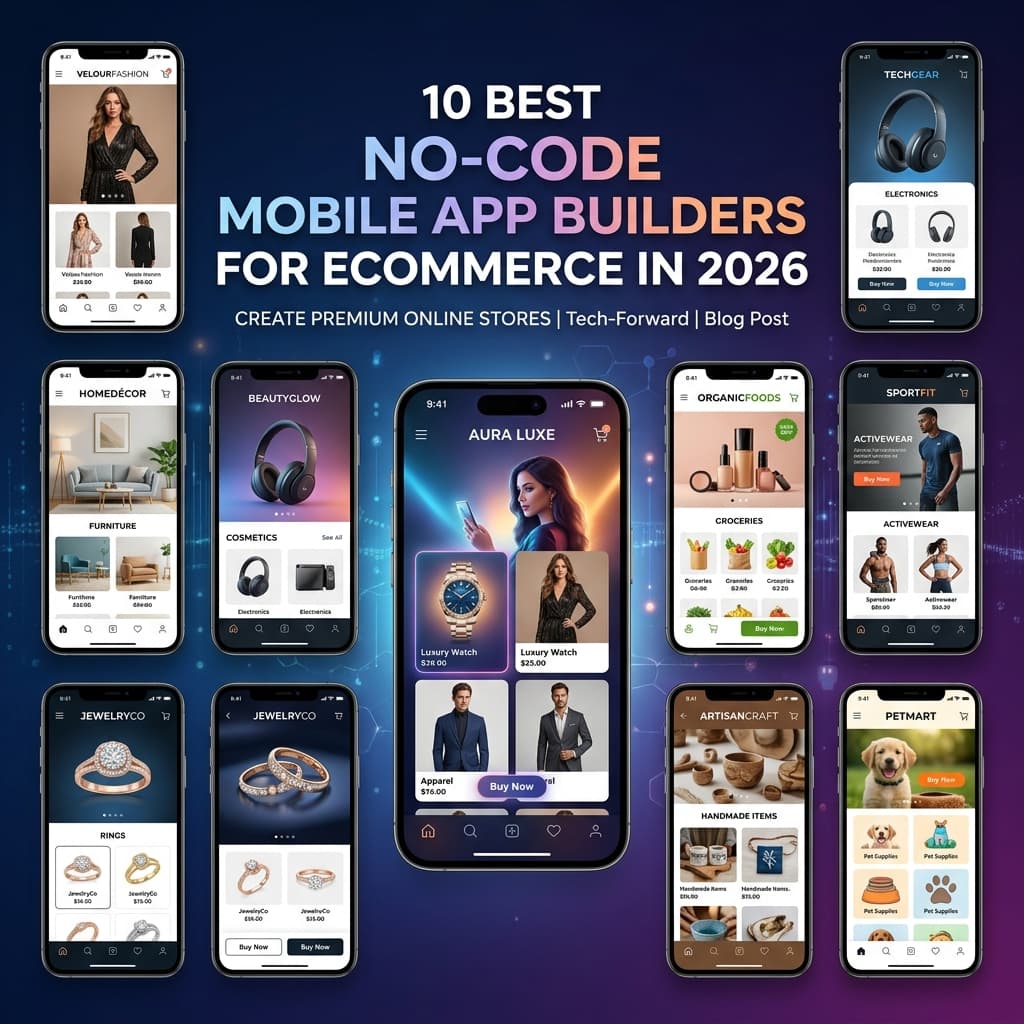
The Rise of the No-Code Mobile App Builder in 2026
Updated May 13, 2026: This comparison now includes the latest feature sets for the top 10 builders, focusing on React Native performance, AI-driven personalization, and deep integration with Shopify and WooCommerce APIs.
In 2026, the question is no longer if your ecommerce store needs a mobile app, but how you will build it. With mobile traffic consistently accounting for over 75% of ecommerce visits, the friction of mobile web is a luxury no brand can afford.
The traditional path — hiring an agency for $50,000+ — is being rapidly replaced by the no-code mobile app builder. These platforms allow you to launch high-performance, native iOS and Android apps in days, not months, and for a fraction of the cost.
But with so many options, which one is right for your store? We've analyzed the top 10 no-code mobile app builders of 2026 to help you decide.
1. BrewmyApp: The ROI Leader for Shopify & WooCommerce
BrewmyApp has emerged as the definitive choice for stores looking for a balance of high-end native performance and aggressive ROI. Unlike many builders that focus exclusively on Shopify, BrewmyApp provides a "first-class" experience for both Shopify and WooCommerce.
Best For: Growth-stage stores that want a premium app without the "enterprise" price tag.
Key Features:
- True React Native Architecture: No WebViews. Sub-second load times and 60fps animations.
- Unified Builder: Manage your Shopify and WooCommerce apps from a single interface.
- Deep Sync: Real-time synchronization of products, inventory, and customer data.
- Unlimited Push Notifications: Included in all plans, with advanced segmentation.
Pricing: $99/month or $999/year per store, all-inclusive. Designing and previewing is free; you pay when you build and publish.
2. Tapcart: The Shopify Enterprise Standard
Tapcart remains a dominant player in the Shopify ecosystem, particularly for high-volume Plus brands. They offer a very polished drag-and-drop builder and strong integrations with the Shopify app ecosystem.
Best For: Large Shopify Plus brands with significant budgets and a need for complex integrations.
Key Features:
- Tapcart Insights: Detailed analytics on app performance.
- Extensive Integration Library: One-click connections to Klaviyo, Yotpo, and Smile.io.
- Custom Blocks: High degree of home screen customization.
Pricing: Enterprise-focused, typically starting at $200+/month for basic plans, scaling quickly.
3. Plobal Apps: Specialized Shopify Retention
Plobal Apps focuses heavily on the marketing and retention side of the app experience. They position themselves not just as a builder, but as a growth partner for Shopify stores.
Best For: Shopify merchants who want heavy guidance on their mobile marketing strategy.
Key Features:
- Growth Consultation: Access to mobile experts to help optimize your app.
- Personalized Push Campaigns: AI-driven notification timing.
- Advanced Segmentation: Target users based on very specific browsing behaviors.
4. AppBrew: High-Performance Shopify Visuals
AppBrew has gained traction by focusing on "the visual experience." Their apps are known for being particularly beautiful and easy to design, with a strong emphasis on the "look and feel" of a high-end fashion brand.
Best For: Fashion and lifestyle brands where visual storytelling is the priority.
Key Features:
- Premium Design Templates: Highly aesthetic starting points.
- Visual Editor: Real-time preview that is very accurate to the final device.
5. Shopney: The Design-First Shopify Builder
Shopney offers a wide range of layout options and is known for its user-friendly design interface. They provide a solid alternative for Shopify stores that want a distinctive look.
Best For: Small to mid-sized Shopify stores that want easy design control.
Key Features:
- Multiple Theme Options: Choose from various "layouts" for your store.
- In-App Chat Integration: Connect directly with customers inside the app.
6. Vajro: The Global Shopify Specialist
Vajro is a popular choice for stores that have a large international presence. They support a wide range of languages and have a strong support team focused on global markets.
Best For: International Shopify stores with multi-language requirements.
Key Features:
- Multi-Language Support: Easy translation management.
- Live Video Shopping: Integration for live selling events.
7. SimiCart: The Legacy Magento & WooCommerce Choice
SimiCart was one of the early players in the mobile app builder space. While they started with Magento, they have expanded into WooCommerce and Shopify.
Best For: Stores still running on Magento or older WooCommerce setups.
Key Features:
- Magento Expertise: Deep understanding of the Magento architecture.
- Customization Services: They offer agency-style services on top of their builder.
8. MobiLoud: The Content-to-App Converter
MobiLoud takes a different approach. Instead of using a dedicated app builder, they "wrap" your existing mobile-optimized website in a native shell (WebView+).
Best For: Content-heavy sites or stores with very complex custom web features that cannot be easily replicated in a builder.
Key Features:
- Full Site Parity: Your app looks and works exactly like your mobile site.
- Fast Setup: Very little "design" work needed if your site is already mobile-optimized.
9. AppMySite: The Budget-Friendly Wrapper
AppMySite is a popular entry-level choice. Like MobiLoud, it relies heavily on your existing website's mobile experience.
Best For: Very small stores or hobbyists who just want a basic app presence.
Key Features:
- Low Cost: One of the cheapest options on the market.
- Simple Setup: Automated conversion of your WordPress site.
10. Nativefy: The Automated WooCommerce Option
Nativefy focuses on a streamlined, automated approach to turning WooCommerce stores into apps. It's designed for speed and simplicity.
Best For: WooCommerce stores that want a "set it and forget it" solution.
Key Features:
- Automated Sync: Focuses on minimal manual configuration.
- Basic Native Features: Includes essential push and navigation.
How to Choose Your No-Code Mobile App Builder
When evaluating these platforms, don't just look at the monthly price. Consider the Total Cost of Ownership (TCO) and the Revenue Potential.
1. Native vs. WebView
In 2026, Native (React Native/Swift/Kotlin) is the standard. Avoid "WebView wrappers" unless you have an extremely complex site that is impossible to replicate. Native apps provide better speed, better offline support, and 3x higher conversion rates.
2. Integration Depth
Does the builder support your essential plugins? If you use Klaviyo for email, Yotpo for reviews, or a specific loyalty program, ensure the builder has a "native" integration or a reliable way to support it.
3. Long-Term Pricing
Some builders charge per-transaction fees (e.g., 1-2% of sales). This might seem small, but as your app grows, this can easily exceed $1,000/month. Look for flat-fee builders like BrewmyApp to keep your margins healthy.
4. Platform Support
If you run on WooCommerce, don't settle for a builder that treats you like a second-class citizen compared to Shopify. Choose a platform that has dedicated WooCommerce experts.
Connecting your store to BrewmyApp
Three ways to connect your store
You do not create an account first. Every route below signs you up and connects the store in the same step.
- From the BrewmyApp homepage. Paste your store URL into the box at the top of brewmyapp.io, approve the install, and you land in the designer with your products already synced.
- From the Shopify App Store. Install BrewmyApp directly from Shopify. The install itself creates your account and links the store — nothing to fill in afterwards.
- From the dashboard. Already have a store connected and want to add another? Add it from your stores page.
Whichever you pick, products, collections, variants, and inventory sync automatically. There is no CSV export and no API key to paste.
Building and publishing the app
Builds run on Expo's EAS infrastructure, so nothing compiles on your machine:
- Connect an Expo account. Free to create at expo.dev; the dashboard walks you through linking it.
- Pick your target. Android APK for side-loading and testing, Android AAB for Google Play, iOS IPA for the App Store, or both at once. iPad support is a checkbox.
- Choose the app language. Eleven locales ship built in — English, Spanish, French, German, Portuguese, Italian, Dutch, Hindi, Arabic, Japanese, and Chinese.
- Build. You watch the EAS log stream in the dashboard and get the artifact when it finishes.
- Submit. Turn on auto-submit and the build goes to App Store Connect or Google Play on completion, or download the artifact and upload it yourself.
iOS publishing needs an Apple Developer Program membership ($99/year). After the first build, most changes — layout, colours, banners, product arrangement — ship over the air, so your users get them without a new store review.
What BrewmyApp costs
BrewmyApp is $99/month or $999/year per store. Designing your app and previewing it on a real device is free — you pay when you build and publish. The app stores charge separately: Apple's Developer Program is $99/year and Google Play is a one-time $25 fee.
There is no per-order commission, no push notification metering, and no separate charge for iOS versus Android — one plan covers both native apps for that store.
Conclusion: Start Building Today
The barrier to entry for mobile commerce has vanished. Whether you choose the enterprise depth of Tapcart or the aggressive ROI and dual-platform support of BrewmyApp, the most important step is to start.
Create your free account on BrewmyApp today and see your store as a native mobile app in minutes.
Related Reads:
Ready to Turn Your Store into a Mobile App?
Design and preview your app for free. No coding required.
Start Building for Free